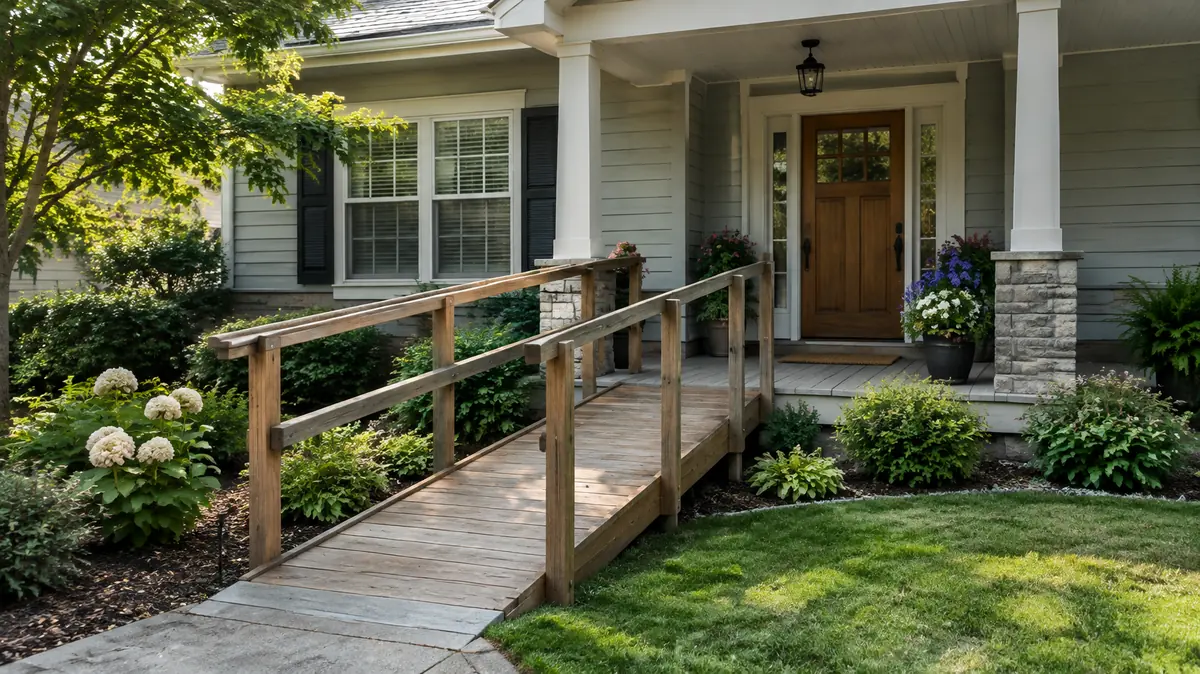
These are the key numbers on where older Americans want to live, who cares for them, and the conditions that most often change what a safe home needs. Each figure comes from the original source and links back to it, with the year it describes.
AgingSteady is an independent research site, not a government agency or research body. We don't produce any of these numbers. We check them against the source and show you where to find them.
Key numbers at a glance
On this page
Staying at home
Share or embed
Free to use with a credit link to this page.
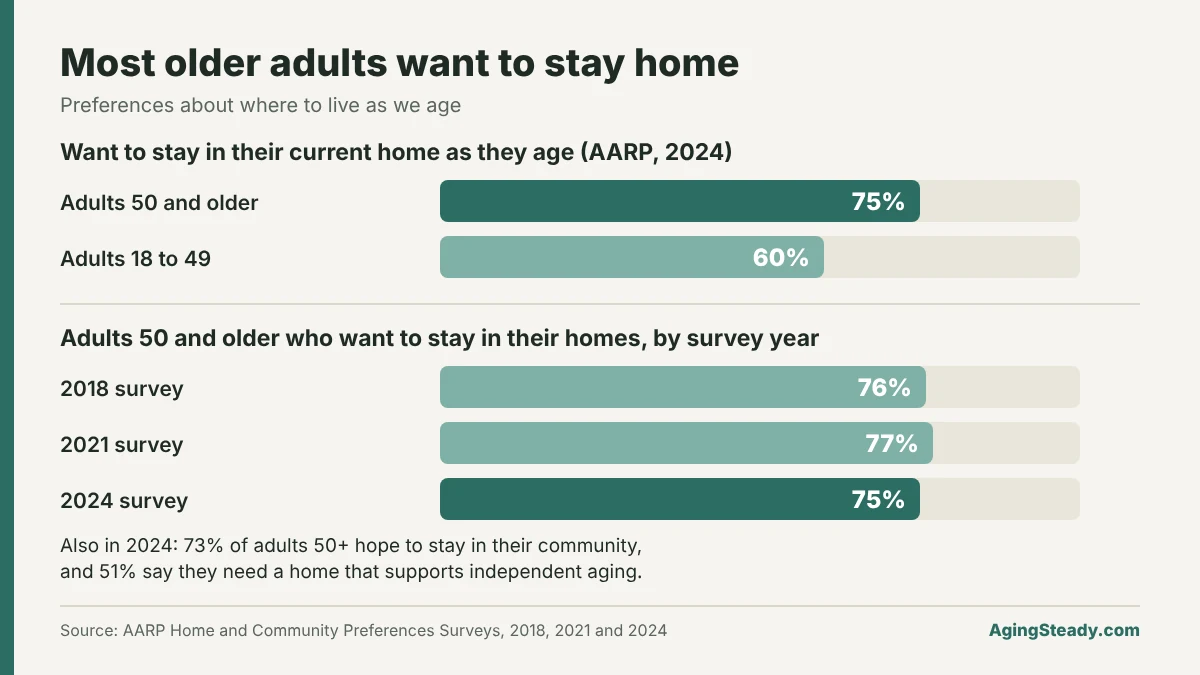
<a href="https://www.agingsteady.com/aging-in-place-caregiving-statistics"><img src="https://www.agingsteady.com/img/info/staying-at-home.png" alt="In AARP's 2024 survey, 75 percent of adults 50 and older and 60 percent of adults 18 to 49 want to stay in their current home. Among adults 50 and older the share was 76 percent in 2018, 77 percent in 2021 and 75 percent in 2024." width="1200" height="675"></a>
| Statistic | What it measures | Data year | Source |
|---|---|---|---|
| 75% | Adults 50 and older who want to remain in their current home as they age (60% of adults 18 to 49). | 2024 survey | AARP: 2024 Home and Community Preferences Survey (press release) |
| 73% | Adults 50 and older who hope to stay in their community (63% of adults 18 to 49). | 2024 survey | AARP: 2024 Home and Community Preferences Survey (press release) |
| 51% | Adults 50 and older who say they need a home that supports independent aging. | 2024 survey | AARP: 2024 Home and Community Preferences Survey (press release) |
| 76% and 77% | Earlier AARP surveys of adults 50 and older who wanted to stay in their homes: 76% in 2018 and 77% in 2021. | 2018 and 2021 surveys | AARP: 2018 Home and Community Preferences Survey AARP: 2021 Home and Community Preferences Survey (press release) |
| One-third (33%) | Adults 50 and older who said their homes would need modifications for them to live there safely and independently. | 2021 survey | AARP: 2021 Home and Community Preferences Survey (press release) |
Method for the 2024 survey: 3,090 U.S. adults aged 18 and over, interviewed online and by phone from June 17 to July 1, 2024. On the 2021 modifications question, AARP's press release gives one-third (33%), while the summary of its full 2021 report gives a similar figure of 34%.
Family caregiving
| Statistic | What it measures | Data year | Source |
|---|---|---|---|
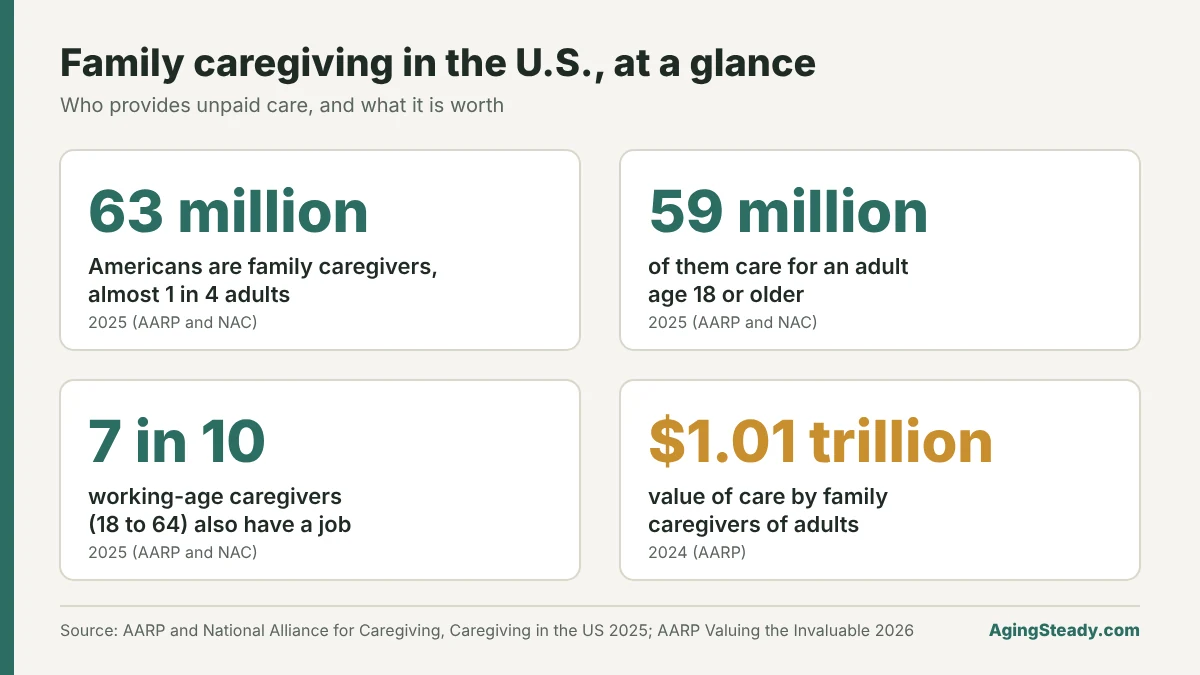
| 63 million | Adults who provide ongoing care to an adult or child with a medical condition or disability, almost one in four (24%) U.S. adults. | 2025 | AARP and National Alliance for Caregiving: Caregiving in the US 2025 National Alliance for Caregiving: Caregiving in the US 2025 highlights (PDF) |
| 59 million | Of those, the number who care for an adult age 18 or older (94% of family caregivers). | 2025 | AARP and National Alliance for Caregiving: Caregiving in the US 2025 AARP Public Policy Institute: Valuing the Invaluable 2026 |
| 45% more | Increase in family caregivers since 2015, from about 43 million to 63 million. AARP's summary page rounds this to a nearly 50% increase. | 2015 to 2025 | National Alliance for Caregiving: Caregiving in the US 2025 highlights (PDF) AARP and National Alliance for Caregiving: Caregiving in the US 2025 |
| About 11 million | Family caregivers who receive some compensation, for example through Medicaid, VA or other state programs. AARP's report includes this group for the first time. | 2025 | AARP and National Alliance for Caregiving: Caregiving in the US 2025 |
| 7 in 10 | Working-age (18 to 64) family caregivers who are also employed. | 2025 | National Alliance for Caregiving: Caregiving in the US 2025 highlights (PDF) AARP and National Alliance for Caregiving: Caregiving in the US 2025 |
| 29% | Share of family caregivers of adults who are "sandwich generation" caregivers, raising children while caring for an adult. That is nearly 17 million people. | 2025 | AARP: Sandwich generation caregivers, Caregiving in the US 2025 AARP and National Alliance for Caregiving: Caregiving in the US 2025 |
| $1.01 trillion | Economic value of the 49.5 billion hours of care provided by 59 million family caregivers of adults, at an average of $20.41 an hour. AARP says it exceeds total Medicaid spending that year ($932 billion). | 2024 | AARP Public Policy Institute: Valuing the Invaluable 2026 AARP: Family Caregivers Account for $1 Trillion in Essential Care |
| 38 million vs. 59 million | Why caregiver totals differ: the Bureau of Labor Statistics counts 38 million unpaid caregivers of older Americans, while the National Alliance for Caregiving and AARP count 59 million caregivers of adults, including paid caregivers and adults of all ages. | Most recent reports | Boston College Center for Retirement Research: Family Caregivers, How Many and Who Are They? AARP and National Alliance for Caregiving: Caregiving in the US 2025 |
Definitions matter. The National Alliance for Caregiving and AARP count adults giving ongoing care to someone with a medical condition or disability, while other surveys define "caregiver" differently and arrive at different totals.
Dementia and wandering
Share or embed
Free to use with a credit link to this page.
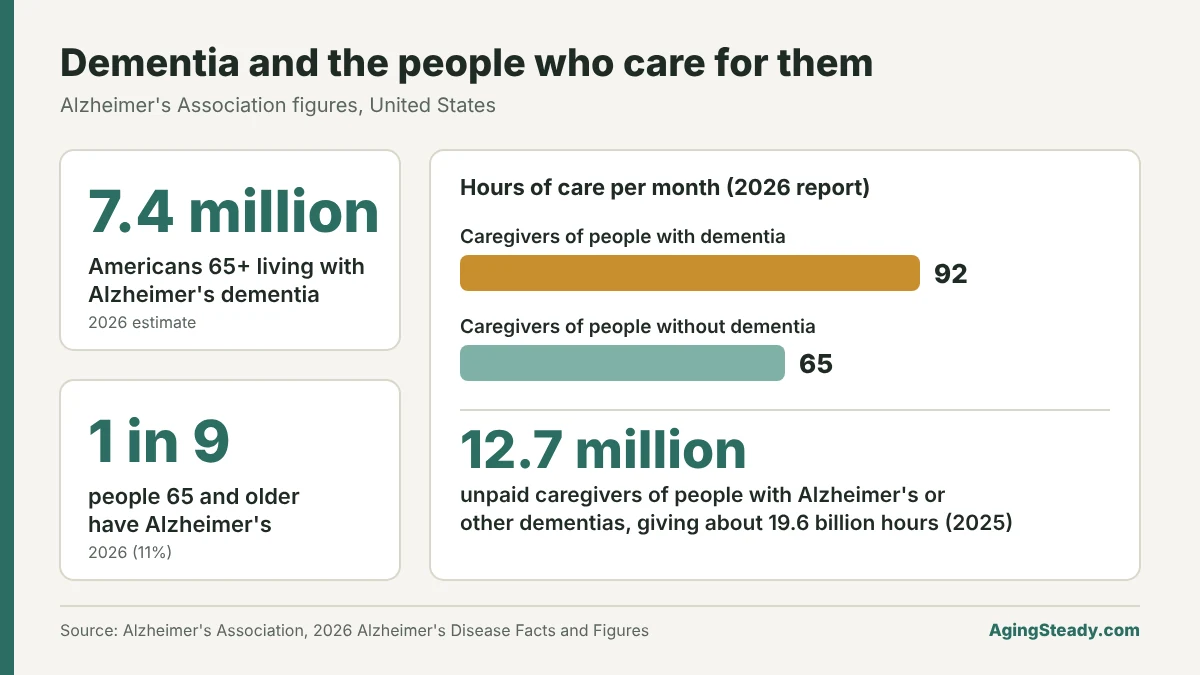
<a href="https://www.agingsteady.com/aging-in-place-caregiving-statistics"><img src="https://www.agingsteady.com/img/info/dementia-and-caregiving.png" alt="7.4 million Americans 65 and older live with Alzheimer's dementia, about 1 in 9. Caregivers of people with dementia report about 92 hours of care a month against 65 for other caregivers. 12.7 million unpaid caregivers gave about 19.6 billion hours in 2025." width="1200" height="675"></a>
| Statistic | What it measures | Data year | Source |
|---|---|---|---|
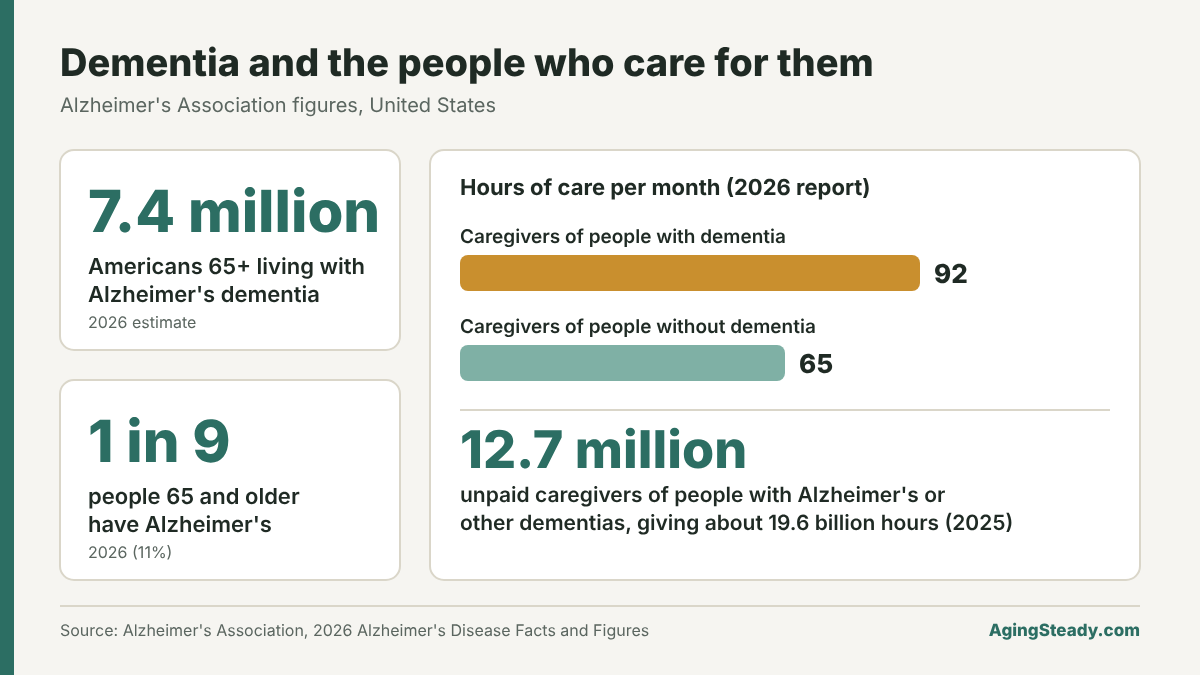
| 7.4 million | Americans age 65 and older living with Alzheimer's dementia. About 74% are 75 or older, and about 1 in 9 people 65 and older (11%) has Alzheimer's. | 2026 estimate | Alzheimer's Association: Facts and Figures 2026 Alzheimer's Disease Facts and Figures (full report, Alzheimer's & Dementia) |
| 12.7 million | Family members and other unpaid caregivers of people with Alzheimer's or other dementias. They provided an estimated 19.6 billion hours of care, valued at $446.3 billion. The Association's summary pages round these to "nearly 13 million" and "more than 19 billion hours." | 2025 | Alzheimer's Association: Facts and Figures 2026 Alzheimer's Disease Facts and Figures (full report, Alzheimer's & Dementia) |
| $409 billion | Total annual cost of caring for people with Alzheimer's and other dementias, not counting unpaid care. | 2026 estimate | Alzheimer's Association: 2026 report release (April 21, 2026) |
| 1 in 3 | Older adults who die with Alzheimer's or another dementia. | 2026 report | Alzheimer's Association: Facts and Figures |
| 83% | Share of the hours of help given to older adults in the U.S. that comes from family, friends and other caregivers, who are often unpaid. Caregivers of people with dementia report about 92 hours of care a month, against 65 for caregivers of people without dementia. | 2026 report | 2026 Alzheimer's Disease Facts and Figures (full report, Alzheimer's & Dementia) |
| 6 in 10 | People living with dementia who will wander at least once, according to the Alzheimer's Association. This is an estimate with contested support: a 2024 peer-reviewed paper notes that published studies put wandering prevalence anywhere from 11% to 50% (another 2024 paper cites 11% to 60%), and calls the prevalence of dangerous "critical wandering" an open question. | Association estimate; 2024 papers | Alzheimer's Association: Wandering Cruz et al., Alzheimer's & Dementia (2024) 2024 study of missing incidents among older adult MedicAlert subscribers, via PubMed Central |
Hearing loss
| Statistic | What it measures | Data year | Source |
|---|---|---|---|
| 22% and 55% | Adults 65 to 74 (22%) and adults 75 and older (55%) with disabling hearing loss, defined as hearing loss of 35 decibels or more in the better ear. | National survey data, 2015 to 2020 | NIDCD: Quick Statistics About Hearing, Balance & Dizziness |
| Fewer than 1 in 3 (30%) | Adults 70 and older with hearing loss who could benefit from hearing aids and have ever used them. | NIDCD statistics page, accessed Oct. 2026 | NIDCD: Quick Statistics About Hearing, Balance & Dizziness |
Numbers that changed
Some older figures are still repeated widely after the source has updated them. If you’re citing a number, check it against this table first.
| Older figure still circulating | Current figure | What changed | Source |
|---|---|---|---|
| 7.2 million Americans 65+ with Alzheimer's dementia (2025 report) | 7.4 million (2026 report) | The Alzheimer's Association updates its estimate every year, so figures from last year's edition are already out of date. | Alzheimer's Association: 2025 report release (April 29, 2025) Alzheimer's Association: Facts and Figures |
| Nearly 25% of ages 65 to 74 and 50% of ages 75+ with disabling hearing loss | 22% and 55% | The older figures are still widely repeated, including on sites that copy NIDCD's earlier text, which cites 1999 to 2010 survey data. NIDCD's current statistics page gives the newer figures, calculated from 2015 to 2020 survey data. | NIDCD: Quick Statistics About Hearing, Balance & Dizziness |
| About 43 million family caregivers (2015 survey) | 63 million (2025) | The National Alliance for Caregiving describes this as a 45% increase since 2015, and AARP's summary page rounds it to nearly 50%. | National Alliance for Caregiving: Caregiving in the US 2025 highlights (PDF) AARP and National Alliance for Caregiving: Caregiving in the US 2025 |
Share or embed
Free to use with a credit link to this page.
<a href="https://www.agingsteady.com/aging-in-place-caregiving-statistics"><img src="https://www.agingsteady.com/img/info/caregiving-at-a-glance.png" alt="Family caregiving figures: 63 million Americans are family caregivers, 59 million care for an adult, 7 in 10 working-age caregivers are employed, and the care is valued at $1.01 trillion in 2024." width="1200" height="675"></a>
How we verified these figures
- Checked against the source. Each figure was compared with the text of the original organization’s own page, report or study abstract, not copied from another website. In some cases we worked from that page’s text as published in a search index rather than the full page, so before you publish a number, open the linked source.
- Always with a year. Every figure shows the year it describes, because many statistics are revised annually and older versions keep circulating.
- As the source states them. We use the source’s own numbers. Where a source gives a range or calls something an estimate, we say so.
- Disagreements are shown. Where figures have changed or sources differ, the “Numbers that changed” table lists both.
- Corrections welcome. If you find a figure that has changed or is wrong, email hello@agingsteady.com and we’ll check and correct it.
Cite this page
AgingSteady Editorial Team. “Aging in Place and Family Caregiving Statistics.” AgingSteady, last verified October 2026. https://www.agingsteady.com/aging-in-place-caregiving-statistics
For any individual figure, please cite the original source linked in its row. Press and research questions: hello@agingsteady.com. Download all of our statistics as a CSV file (with sources and data years).
Common questions
How many Americans are family caregivers?
63 million American adults, almost one in four (24%), provided ongoing care to an adult or child with a medical condition or disability in 2025, according to AARP and the National Alliance for Caregiving. Of those, 59 million cared for an adult.
What percentage of older adults want to age in place?
In AARP's 2024 survey, 75% of adults 50 and older said they want to remain in their current homes as they age and 73% hope to stay in their communities. Earlier AARP surveys found 76% in 2018 and 77% in 2021.
How many Americans have Alzheimer's disease?
The Alzheimer's Association estimates that 7.4 million Americans age 65 and older are living with Alzheimer's dementia in 2026, about 1 in 9 people in that age group.
How common is wandering in dementia?
The Alzheimer's Association says six in 10 people living with dementia will wander at least once. That is an estimate: a 2024 peer-reviewed paper notes that published studies put the prevalence anywhere from 11% to 50%, so the true figure is less certain than the headline number suggests.