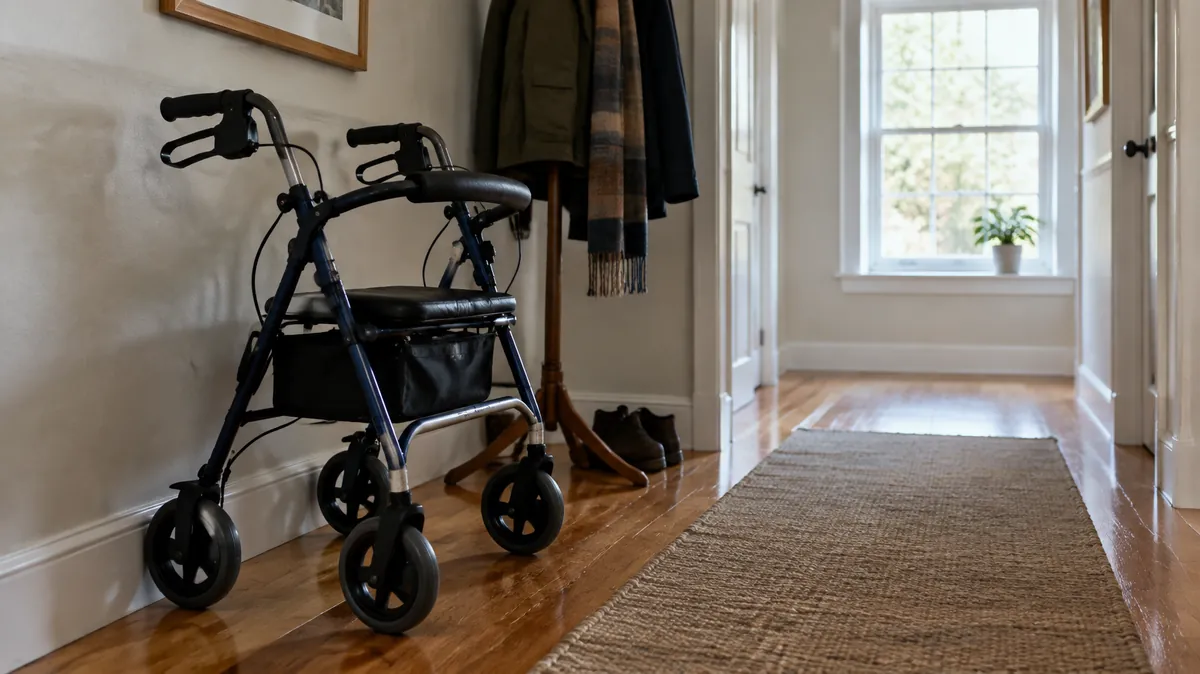
You can see your parent reaching for the wall, the counter, the back of a chair. A walker or cane would help, and they will not hear of it. This is one of the most common standoffs in caregiving, and it is rarely about stubbornness. A walker is visible. To many people it announces a loss they are not ready to admit.
This guide covers why parents say no, how to raise it so it lands better, why a proper fitting matters, and what the evidence says about walkers and falls.
The short answer
Find out what bothers your parent about the device. Get a physical or occupational therapist to choose and fit one, because the right size and correct use are what make walkers and canes safe. Frame it around what your parent wants to keep doing, not around what they cannot do. And do not buy one on your own first.
In this guide
Why do parents refuse?
| What they say | What may be behind it | What might help |
|---|---|---|
| “I don’t need it” | They do not feel unsteady, or do not want to admit it | A therapist’s balance check, so it is not just your opinion |
| “It makes me look old” | Stigma and fear of losing independence | Let them choose the style, and tie it to something they want to keep doing |
| “It gets in the way” | Wrong size, wrong type, or never taught how to use it | A fitting and a lesson. A rollator may suit some people better; ask the therapist |
| “I’ll fall over it” | A reasonable worry if it is the wrong device or fit | Get it checked, practice indoors, and clear the home of trip hazards |
| Says nothing, just won’t use it | Pain, memory changes, or difficulty using it | Ask the doctor whether something else is going on |
How do you bring it up?
The American Geriatrics Society’s caregiver guide says that if an older person is even a little unsteady, a cane or walker is advised, and that a physical therapist can teach safe use and adjust it to the right height. Its suggested answer to “I don’t need a walker” is to point out that using one helps a person keep walking independently, rather than ending up in a wheelchair or nursing home.
A recent American Geriatrics Society workgroup report on fall prevention recommends framing elements to improve engagement and reduce stigma: treating fall risk as a chronic condition, discussing the patient’s mobility goals and not only fall reduction, and replacing “fear” or “worry” of falling with “concern.” It is written for clinicians, but the same words help at the kitchen table. In practice:
- Ask first. “What bothers you about it?” gives you something to solve.
- Start from their goals. “What do you want to keep doing?” The garden, church, the grandchildren’s games. Then ask what would help.
- Make it a trial, not a verdict. A short try with a therapist costs nothing and commits nobody.
- Offer choices. Cane, walker, rollator, color, style. Let them decide.
- Have the doctor raise it. A parent who dismisses you may listen to a doctor or therapist.
- Practice indoors. Short, calm walks at home before using it outside.
Why does fitting matter?
NIA says that using canes and walkers correctly can help prevent falls. If your doctor tells you to use one, make sure it is the right size, walker wheels should roll smoothly, and a borrowed device should be checked by a provider for size and safety. A physical or occupational therapist can help you decide which devices might help and teach you to use them safely. That is the strongest practical reason not to buy one on a hunch: a device that does not fit can be worse than none.
If a rollator, a wheeled walker with brakes, seems more acceptable to your parent, ask the therapist whether it is safe for them, since it rolls and needs brake control. Our rollator guide compares options by use case, and our Medicare coverage guide covers what may be covered.
What does the research say?
A common worry is that walkers cause falls. An analysis of the National Health and Aging Trends Study, by the physical therapist Gell and summarized in 2015, found that people who use mobility devices did not fall more than people who do not. Cane users were, however, more likely to report limiting their activity because of fear of falling. The takeaway is not that a device guarantees safety. People who need one are often already at higher risk, which is why fit, training and the rest of the home matter.
NIA adds that many older adults fear falling even if they have not fallen, and that this fear may lead them to avoid activities such as walking, shopping or social events. For the bigger picture, see our fall prevention exercises guide and falls statistics.
How we handle this guide
AgingSteady earns a commission on some links, which is explained in our affiliate disclosure. This guide links to no product seller and recommends no specific walker, and nothing here is medical advice.
Common questions
Why does my elderly parent refuse to use a walker?
Usually because it feels like a public sign of decline and a step toward losing independence, not because they do not understand the risk. Some also do not feel unsteady, find the device awkward, or were never fitted or shown how to use one. The American Geriatrics Society's guidance for clinicians recommends discussing a patient's mobility goals, not only fall reduction, and framing the issue as concern rather than fear, which also works well at home.
Do walkers make older people fall more?
Not on the evidence we found. An analysis of the National Health and Aging Trends Study, by the physical therapist Gell and summarized in 2015, found that people who use mobility devices did not fall more than those who do not. Cane users, however, were more likely to report limiting their activity because of fear of falling. People who need a device are often already at higher risk, so a device that is the wrong size or used incorrectly can still be a hazard.
How do I get my parent to use a cane or walker?
Begin with what bothers them rather than with the device. The American Geriatrics Society's caregiver guide suggests a physical therapist, who can pick the device, adjust it to the right height and teach safe use, and suggests asking whether using a walker is worth it to stay independent and out of a wheelchair or nursing home. Tie it to something they care about, such as getting to the garden or a friend's house, and let them choose among options.
What is the best walker or cane for an elderly person?
That depends on their balance, strength and where they will use it, so ask a physical or occupational therapist. NIA says a therapist can help you decide which devices might be helpful and teach you to use them safely. Our rollator guide compares wheeled walkers by use case, but it is not a substitute for a fitting.
Should I buy a walker before they see a doctor or therapist?
It is better to ask first. NIA says that if you are told to use a cane or walker it should be the right size, that walker wheels should roll smoothly, and that borrowed equipment should be checked by a health care provider for size and safety. A device bought on a hunch may not fit, and a poor fit can make it unsafe.
What if my parent has dementia and won't use a walker?
Ask their doctor or a therapist to assess whether they can use a device safely, since using a walker takes memory and coordination. If they cannot, other measures, such as supervision, a safer home, and help with walking, may matter more. Our guide to dementia monitoring covers the safety layers that sit around a person who may not use a device.
One important caveat
This guide is general information and is not medical advice. Unsteadiness can have medical causes. Ask your parent’s doctor about falls, and ask a physical or occupational therapist to choose and fit any device.
Sources
National Institute on Aging, Falls and Fractures in Older Adults: Causes and Prevention (we could not open NIA pages directly and rely on its indexed text). · American Geriatrics Society Health in Aging, Caregiver Guide: Mobility Problems (read from an excerpt). · Updating STEADI for Primary Care: Recommendations From the American Geriatrics Society Workgroup (read from an excerpt). · ScienceDaily’s 2015 summary of Gell’s analysis of the National Health and Aging Trends Study (a news summary; we did not read the paper itself, and it is an older study). We saw a frequently repeated figure that about 60% of people who need a cane or walker refuse one, but it traced only to a patent filing, so we do not use it. We welcome corrections through our contact page.