Most families end up paying for a stairlift themselves, or piecing together help from a few places. There are real programs, but each has limits, and some well-known ones, such as the VA’s main home-improvement grant, specifically exclude stairlifts. This guide goes through what exists, what it can pay, who qualifies, and what to ask, using the programs’ own pages where we could read them.
For what a stairlift costs, see our cost guide. For the Medicare side in more detail, see our Medicare coverage guide.
The short answer
Original Medicare generally does not cover stairlifts. The most realistic sources of help are a state Medicaid waiver (if your parent qualifies), a Medicare Advantage plan’s extra benefits, a local nonprofit or Area Agency on Aging program, and the medical-expense tax deduction. The VA’s HISA grant excludes stair glides. Always ask a program whether a stairlift specifically qualifies, since most are written around “home modifications” in general.
In this guide
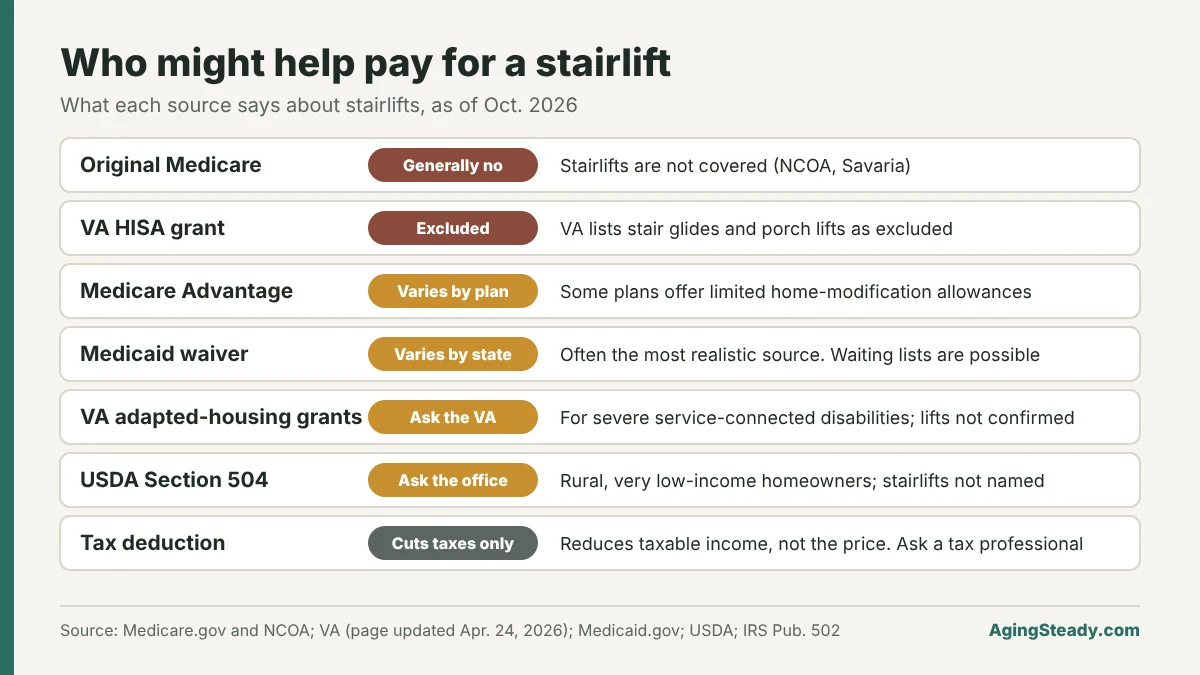
What help exists, at a glance
Share or embed
Free to use with a credit link to this page.
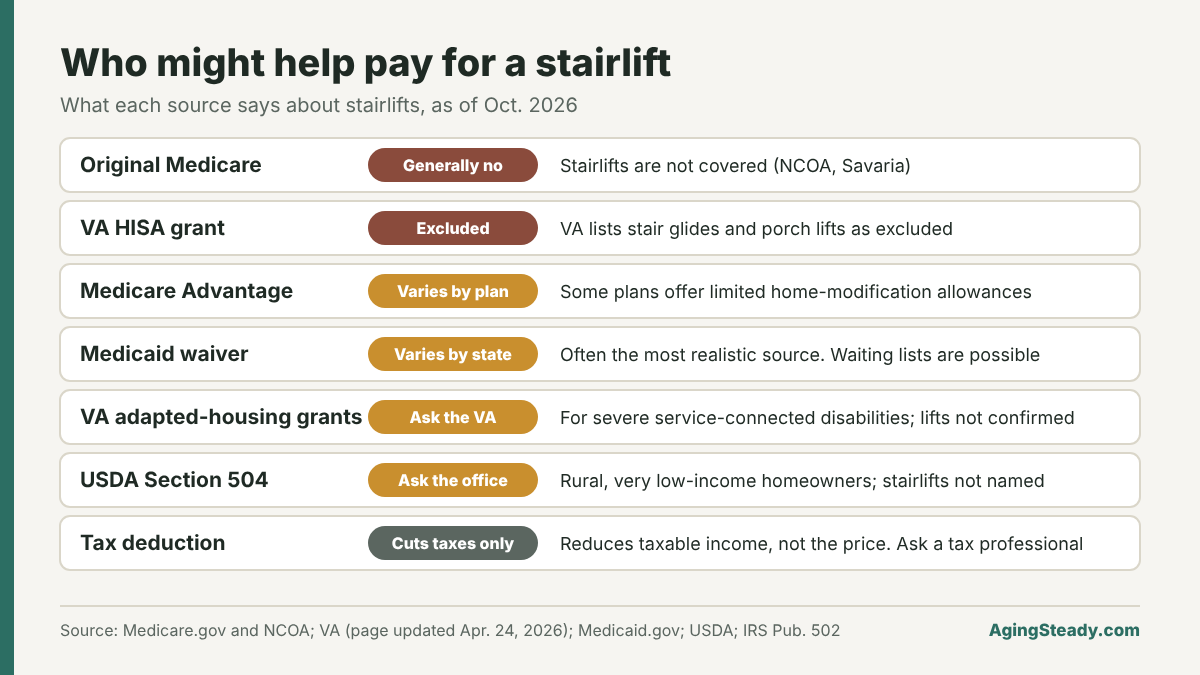
<a href="https://www.agingsteady.com/how-to-get-help-paying-for-a-stairlift"><img src="https://www.agingsteady.com/img/info/stairlift-help-paying-options.png" alt="Sources of help paying for a stairlift: Original Medicare generally does not cover it; the VA HISA grant excludes stair glides; Medicare Advantage varies by plan; Medicaid waivers vary by state; VA adapted-housing grants and USDA Section 504 need a direct question; the medical-expense tax deduction only reduces taxable income." width="1200" height="675"></a>
| Source | Who it is for | How much | Stairlifts? |
|---|---|---|---|
| Original Medicare | People with Medicare | None for stairlifts | Generally not covered (NCOA, Savaria) |
| Medicare Advantage | Members of a plan that offers it | Varies by plan | Some plans give limited home-modification allowances (NCOA). Check your plan. |
| Medicaid HCBS waiver | Low-income people who meet the state’s care-need rules | Set by each state | Varies by state. Waiting lists and enrollment caps are possible. |
| VA HISA grant | Veterans in VA health care | $6,800 lifetime, or $2,000 for some veterans | VA lists stair glides and porch lifts as excluded |
| VA SAH and SHA grants | Veterans with certain severe service-connected disabilities who own the home | Up to $126,526 (SAH) or $25,350 (SHA), FY 2026 | VA names ramps and wider doorways as examples. Ask the VA about lifts. |
| USDA Section 504 | Very low-income homeowners in eligible rural areas; grants for ages 62+ | Loan up to $40,000, grant up to $10,000, $50,000 combined | Funds repairs and health and safety fixes. Ask whether a stairlift qualifies. |
| Rebuilding Together Safe at Home | Older adults, through local affiliates that set eligibility | No-cost modifications | Ask your local affiliate what it installs |
| Medical-expense tax deduction | People who itemize and have large medical costs | Reduces taxable income, not the price | IRS lists “other forms of lifts” as generally not raising home value |
Medicaid waivers: the most realistic source of real money
Regular Medicaid rarely pays for home modifications, but many states run home and community-based services (HCBS) waivers that do. Medicaid.gov describes these waivers as letting states provide long-term care services in the home or community, and says nearly all states and DC offer them. Home modifications under these waivers are often called environmental accessibility adaptations; Utah’s Medicaid program, for example, has published a waiver service of that name.
The limits matter. Which items a state covers, including whether a stairlift is on the list, differs by state. The dollar cap differs too. And Medicaid.gov says states choose the maximum number of people a waiver serves, which the Congressional Research Service notes can lead to waiting lists. Many commercial guides list states that cover stairlifts, but we could not verify each state, so ask your state Medicaid office or your Area Agency on Aging directly.
If your parent is on Medicaid or might qualify, ask: “Does our state’s waiver cover home modifications, is a stairlift eligible, what is the cap, and is there a waiting list?”
VA grants: read the exclusions first
HISA. The VA’s Home Improvements and Structural Alterations benefit has a lifetime limit of $6,800 for most service-connected situations and $2,000 for other veterans, according to a VA health care page updated April 24, 2026. The same page lists “porch lifts, and stair glides” among its excluded alterations, so HISA generally will not pay for a stairlift. It does cover items such as permanent ramps and roll-in showers when medically justified. Some third-party sites say HISA covers chair lifts; the VA’s own page says otherwise, so we followed the VA.
SAH and SHA. The VA’s Specially Adapted Housing grant (up to $126,526 for FY 2026) and Special Home Adaptation grant (up to $25,350) are for veterans with certain severe service-connected disabilities, such as loss of use of more than one limb, and require that you (or, for SHA, a family member) own the home. The VA’s page gives ramps and wider doorways as examples of changes and does not mention stairlifts. A stairlift may be part of an approved plan for an eligible veteran, but we could not confirm that from a VA source, so ask the VA before counting on it.
A VA social worker or your local VA Prosthetic and Sensory Aids Service, which administers HISA, is the best first call.
USDA and nonprofit programs
USDA Section 504. USDA’s Single Family Housing Repair program offers loans of up to $40,000 to very low-income homeowners and grants of up to $10,000 to those aged 62 and older, with up to $50,000 combined, in eligible rural areas. Loans are repaid over 20 years at a fixed 1 percent interest rate, and grants must be repaid if the home is sold within three years. The program says loans can be used to repair, improve or modernize a home and that grants are for removing health and safety hazards. It does not name stairlifts, so ask your local USDA office whether one qualifies and whether your address is eligible.
Rebuilding Together. Its Safe at Home program provides no-cost home modifications for older adults to reduce falls, delivered through local affiliates that set their own eligibility. Descriptions of the program mention items such as grab bars, ramps and handrails, so ask what your local affiliate installs.
HUD-funded programs. In 2021, HUD awarded $30 million to 32 organizations, including Rebuilding Together and Habitat for Humanity affiliates, for low-cost home modifications for low-income elderly homeowners. We do not know which programs are running near you now, so ask your Area Agency on Aging.
The tax deduction, HSA and FSA
IRS Publication 502 allows you to include as medical expenses special equipment installed in a home, or improvements, if the main purpose is medical care. You subtract any increase in your home’s value, and the difference is the medical expense. The publication lists improvements that generally do not raise a home’s value, which includes installing “porch lifts and other forms of lifts.” It does not name stairlifts, so confirm with a tax professional. We read the IRS wording as reproduced by tax-software and state agency pages, not on the IRS site itself.
Two practical limits. You can only deduct if you itemize, and only the part of your total medical expenses above a percentage of your income. Sources give the threshold as 7.5 percent of adjusted gross income, which you should confirm for the current tax year. Who can claim a parent’s expenses depends on your situation, so ask a tax professional. Sources suggest keeping a doctor’s letter documenting medical need.
A health savings account or flexible spending account may also pay, since they follow medical-expense rules. One employer guide lists lifts among reimbursable capital expenses, but plans differ, so ask your plan administrator first.
Local help to ask about
- Your Area Agency on Aging. The federal Eldercare Locator can point you to yours. Ask about home modification programs, loan closets and local grants.
- Your state’s assistive technology program. Some run equipment exchanges and loan programs. See our used stairlift guide for reuse programs.
- Renting. If the need is temporary, NCOA says many companies rent standard stairlifts for $300 to $500 a month, with installation and a deposit often extra.
- Used or refurbished. NCOA puts a used straight stairlift at about $1,500 to $3,000. Details in our used stairlift guide.
- A cheaper alternative. Depending on the stairs, other options may cost less. See our alternatives guide.
Be careful with “free stairlift” offers
Ads that promise a free stairlift, or say Medicare will pay for one, deserve scrutiny. NCOA and the manufacturer Savaria both say Original Medicare generally does not cover stairlifts. Before paying a deposit or giving personal or insurance details, check the company’s reviews, get the quote in writing, and confirm any coverage claim with your plan directly.
What to do, in order
- Get two written quotes so you know the real number. Our cost guide has current ranges.
- Call your Area Agency on Aging and ask what home modification help exists locally.
- If your parent has Medicaid, ask about the state HCBS waiver and whether a stairlift qualifies.
- If your parent has Medicare Advantage, call the plan and ask about home-modification allowances. Open enrollment runs October 15 to December 7; our checklist helps compare plans.
- If your parent is a veteran, ask the VA about adapted-housing grants, keeping in mind that HISA excludes stair glides.
- If the home is in a rural area and your parent has a very low income, contact USDA Rural Development.
- Talk to a tax professional about the medical-expense deduction and any HSA or FSA funds.
- Compare used, rented or alternative options if nothing else covers it.
How we handle this guide
AgingSteady earns a commission on some links, which is explained in our affiliate disclosure. This guide links to no stairlift seller, and nothing here is legal, tax or benefits advice. Program amounts and rules change, so confirm every figure with the program before relying on it.
The Aging Parent Emergency Info Sheet
Medications, contacts and legal info on one page, ready for a paramedic or hospital.
Common questions
Does Medicare pay for a stairlift?
Generally no. NCOA says Medicare does not typically cover stairlifts because it classifies them as home modifications rather than durable medical equipment, and the manufacturer Savaria says the same. Some Medicare Advantage plans offer limited allowances for home modifications, so check your plan's benefits.
Can I get a stairlift for free?
Rarely, and usually only through a program tied to income, disability or veteran status, such as a state Medicaid waiver or a local nonprofit home-repair program. Be cautious about any ad promising a free stairlift or claiming Medicare will pay, since that contradicts what NCOA and the manufacturer Savaria say about Medicare.
Does Medicaid pay for a stairlift?
Sometimes. Many states use Medicaid home and community-based services waivers to pay for home modifications, which some call environmental accessibility adaptations. Whether a stairlift is covered, how much the state will pay, and whether there is a waiting list all vary by state. Medicaid.gov says states choose the maximum number of people a waiver serves.
Does the VA pay for a stairlift?
Not through its main home-improvement grant. A VA health care page lists stair glides and porch lifts among the exclusions from the HISA grant. The larger Specially Adapted Housing and Special Home Adaptation grants are limited to veterans with certain severe service-connected disabilities, and the VA's page names ramps and wider doorways, not stairlifts, as examples. Ask the VA what applies to you.
Is a stairlift tax deductible?
It may be. IRS Publication 502 allows capital improvements made mainly for medical care as medical expenses, reduced by any increase in your home's value, and lists porch lifts and other forms of lifts among improvements that generally do not raise a home's value. It does not name stairlifts. You can only deduct if you itemize, and only the part of your total medical expenses above a percentage of your income. Ask a tax professional, particularly about who can claim a parent's expenses.
Are there grants for seniors to pay for a stairlift?
There are home-repair programs, but few that clearly pay for a stairlift. USDA's Section 504 program offers grants of up to $10,000 to very low-income homeowners aged 62 and older in eligible rural areas, and loans of up to $40,000. Rebuilding Together's Safe at Home program provides no-cost home modifications through local affiliates. Ask each program whether a stairlift qualifies, because they typically fund safety repairs and modifications more broadly.
Can I use an HSA or FSA for a stairlift?
Possibly. Health spending accounts follow IRS medical-expense rules, and one employer guide lists installing porch lifts and other lifts among reimbursable capital expenses. Plans differ, so ask your plan administrator, and expect to need a doctor's letter documenting medical need.
One important caveat
This guide is general information and is not legal, tax or benefits advice. Eligibility rules and amounts change and vary by state and household. Confirm details directly with Medicaid, the VA, USDA, your plan, or a tax professional before making financial decisions.
Sources
VA Fayetteville Coastal Health Care, Home Improvements/Structural Alterations (HISA) (updated April 24, 2026; read in full). · VA, Disability housing grants for Veterans (updated November 18, 2025; read in full). · USDA Rural Development, Single Family Housing Repair Loans & Grants (a state page) and its program fact sheet (interest rate, term and repayment terms); both read from search excerpts. · Medicaid.gov, Home & Community-Based Services 1915(c) and the Congressional Research Service, Medicaid Section 1915(c) Home- and Community-Based Services Waivers (excerpts). · National Council on Aging, Used Stair Lift Buyers Guide and Savaria, How Much Does a Stairlift Cost in 2026? (Medicare coverage and rental costs; both read in full). · Rebuilding Together, Safe at Home (excerpt), and HUD, 2021 Older Adults Home Modification awards. · IRS Publication 502, read as reproduced by tax-software and state agency pages, and The Tax Adviser, not on the IRS site itself. Many commercial guides, which we did not rely on for amounts, claim broad stairlift coverage that the official pages above do not support. We welcome corrections through our contact page.