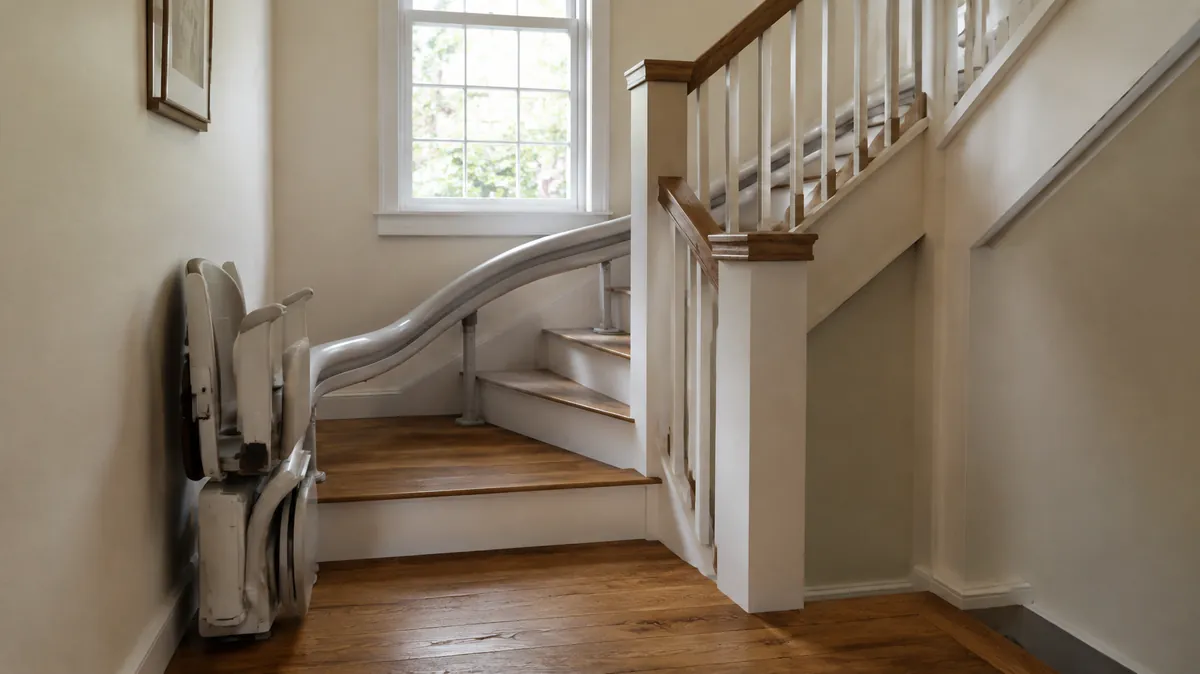
Most stairlift advice assumes one long, straight, indoor staircase. Real homes are messier: three steps up to a back door, a landing halfway, a turn at the top, a basement stairway behind a door. Each of those changes what kind of lift fits, what it costs, and whether a stairlift is even the right answer.
This guide goes through the common layouts and says what manufacturers and dealers report for each. For the price of a lift, see our cost guide.
The short answer
A single straight flight without a landing takes a straight stairlift. A turn, an intermediate landing or pie-shaped stairs take a curved one, according to the manufacturer Savaria. Staircases of only a few steps are often better served by another solution, according to dealers. Narrow stairs need a compact model, and garage or basement stairs need a model rated for the conditions. In every case, ask for a home assessment, because the staircase decides the answer.
In this guide
Your staircase and what usually fits
| Your staircase | What usually fits | What to check |
|---|---|---|
| One straight flight, no landing | A straight stairlift | Width, and room to park at top and bottom |
| One to three steps | Often another solution, such as a ramp or vertical lift (dealers) | A quote, and our alternatives guide |
| A landing between two flights | A curved stairlift, or two straight lifts with a seat change | Landing size and how the flights meet |
| A turn, L-shape, U-shape or pie-shaped steps | A curved stairlift (Savaria) | A detailed survey, since the rail is made for your stairs |
| Split-level or bi-level entry | Depends on each flight: straight, curved, or one per flight | An assessment of every flight |
| Narrow stairs | A compact or narrow-profile straight model | The model’s minimum width and folded depth |
| Garage, basement or porch steps | A model rated for the conditions, such as an outdoor package | Temperature, moisture and the manufacturer’s rating |
What about very short staircases?
A stairlift is built around a rail, a seat and room to get on and off, which makes it a heavy tool for a few steps. Dealer guidance is consistent. One says a staircase of one to three steps is usually better served by a wheelchair ramp or a vertical lift. Another says that if there is only one step between the landings the stairs are likely too short, while two steps can often take a lift. These are dealer opinions rather than manufacturer limits, and we found no manufacturer minimum.
If your parent’s trouble is only a few steps at a door, consider cheaper steps first: a second handrail, a ramp where there is room, better lighting, or help from our alternatives guide. If your parent uses a wheelchair and cannot transfer to a seat, Savaria says a stairlift is usually the wrong product, and a wheelchair lift or elevator fits better.
Landings, turns and split levels
Savaria says a staircase with a turn, an intermediate landing or pie-shaped stairs needs a curved stairlift. A curved rail is built for one staircase: the stairs are measured or digitally surveyed, and the rail is fabricated to follow the exact turns and angles. That is why curved lifts cost more. Savaria puts curved lifts at $10,000 to $25,000 installed, and says one simple 90-degree turn generally costs less than a long staircase with several turns and landings.
- One continuous ride. A curved lift carries the rider around the landing without changing seats. One review site notes that two straight lifts, one per flight, are an alternative, but the rider has to move from one seat to the other.
- Tight turns. Savaria lists tight turns as possible on its Stairfriend 23 and Handicare 4000 curved models.
- Parking. A curved rail can include a bend that parks the chair out of the way at the top or bottom, which Savaria says gives more room to get on and off.
- Lead time. Because the rail is made to order, expect it to take longer than a straight lift, which Savaria says can be installed in a few hours.
- If you may move. A curved rail usually cannot be reused in another home. See our used stairlift guide.
Split-level homes vary too much for one rule. Where short flights are separated by a landing or change direction, you generally need a curved lift or a separate lift for each flight. Have every flight assessed.
Narrow staircases
Width is the most common limit. Dealers commonly give a minimum of about 28 to 30 inches of clear staircase width for a straight stairlift, with a rail that projects roughly 6 to 9 inches from the wall, and one guide says a few narrow-profile models go down to about 26 to 27 inches. Treat those as rules of thumb, since each model differs.
Savaria describes two of its straight models as suited to narrow staircases: the K2, with a folded depth of 10 and three-quarter inches, and the Handicare 1100, with a folded depth of 12 and three-quarter inches. Its Handicare 1000 offers a perch seat, a partly standing option. Folded depth matters because anyone else using the stairs has to pass the folded lift. We have not tested any model, so check each manufacturer’s measurements and ask the installer to measure.
Garage, basement and outdoor steps
Stairs in a garage, an unfinished basement or on a porch can be cold, damp or exposed to weather. Indoor models are not built for that. Savaria lists an outdoor package on some models, and its comparison says one of its straight models is suitable outdoors in mild climates only. Ask the dealer whether the specific model is rated for the temperatures and moisture on your stairs. Our cost guide has outdoor price ranges.
Space at the top and bottom
A stairlift rail extends beyond the stairs so the rider can get on and off, and the chair needs somewhere to stop. Dealers say the rail commonly runs about 18 inches past the top and bottom of the stairs, that a lift needs roughly 24 to 30 inches of space beyond the bottom step for parking, and that a landing about 36 inches wide helps someone mount and dismount safely. These are dealer figures, not manufacturer minimums.
Doors that open onto the stairs, radiators and tight corners can all get in the way. A hinged rail, which Savaria lists as an option on its straight models, folds up when not in use, and a curved rail can park the chair around a bend. Ask the installer how they would handle the space at both ends of your stairs.
What should you measure before you call?
NCOA lists the measurements to have ready: total length of the staircase, width, number of steps, top and bottom clearances, and the presence of doors, railings or landings. Photos of the whole staircase, including both ends, help too. Savaria says its dealers can use a photo-measuring system for an accurate survey, and the best way to get an accurate price is a home assessment. Our cost guide includes a free assessment request.
How we handle this guide
AgingSteady earns a commission on some links, which is explained in our affiliate disclosure. We have not tested any stairlift, and nothing here is a product recommendation. Width and space minimums vary by model, and the dealer figures above are rules of thumb, so rely on the manufacturer’s measurements and your installer.
Common questions
Can you put a stairlift on just three steps?
Sometimes it is technically possible, but it is often the wrong tool. One dealer says a staircase with only one to three steps is usually better served by a ramp or a vertical lift, and another says a single step is too short while two steps may work. Because a stairlift needs a rail, a seat and parking space, ask for a home assessment and compare it with the alternatives before deciding. Our alternatives guide covers handrails, ramps and other options.
Do I need a curved stairlift if my stairs have a landing?
Usually, yes, if you want one continuous ride. Savaria, a manufacturer, says a staircase with a turn, an intermediate landing or pie-shaped stairs needs a curved stairlift, because the rail is custom-made to follow the stairs. One review site notes that you could instead use two straight lifts, one for each flight, but the rider then has to change seats at the landing.
Can a stairlift go around a corner?
Yes, with a curved stairlift. Savaria says its curved models are made to measure and lists tight turns as possible on two of them. The rail is built for your staircase, so it needs a detailed survey. Savaria says a staircase with one simple 90-degree turn generally costs less than a long one with several turns and landings.
How narrow can stairs be for a stairlift?
It depends on the model, so check the manufacturer's measurements. Dealers commonly give a minimum of about 28 to 30 inches of staircase width for a straight stairlift, and one guide says a few narrow-profile models go to about 26 to 27 inches. Savaria describes its K2, which has a folded depth of 10 and three-quarter inches, as compact and best for narrow staircases. Always have the installer measure, because the rail projects into the stair width even when the seat is folded.
Can I put a stairlift in a garage or basement stairway?
Possibly, but ask. Garage and unfinished basement stairs can be cold, damp or exposed to temperature swings that indoor models are not built for. Savaria lists an outdoor package on some models and says one of its straight models is suitable only in mild climates outdoors. Ask the dealer whether the specific model is rated for the conditions on your stairs.
Can one stairlift serve a split-level house?
It depends on the layout. A single straight lift serves one straight flight. Where flights are separated by a landing or change direction, you generally need a curved lift or a separate lift for each flight. Because split-level homes vary a lot, a home assessment of every flight is the only reliable way to know what you need and what it will cost.
One important caveat
This guide is general information and is not advice about your home or your parent’s mobility. A trained installer must assess your staircase, and an occupational therapist or doctor can advise on whether a stairlift suits your parent.
Sources
Savaria (manufacturer), How Much Does a Curved Stairlift Cost in 2026? (updated September 15, 2026) and How Much Does a Stairlift Cost in 2026? (October 5, 2026), both read in full, and Compare Savaria Straight and Curved Stairlifts (updated September 11, 2026; read in full). · NCOA, Used Stair Lift Buyers Guide (measurements; read in full). · Dealer pages, read from search excerpts, for the short-staircase, width and space figures, including Mobility Plus Colorado, Arrowlift, Lifeway Mobility and DME Elevators & Lifts, and review sites PayingForSeniorCare and LiftChairGuide. We found no manufacturer minimum for staircase length, and Savaria’s product pages we read do not state minimum widths, so the width and space figures above are dealer rules of thumb. We welcome corrections through our contact page.