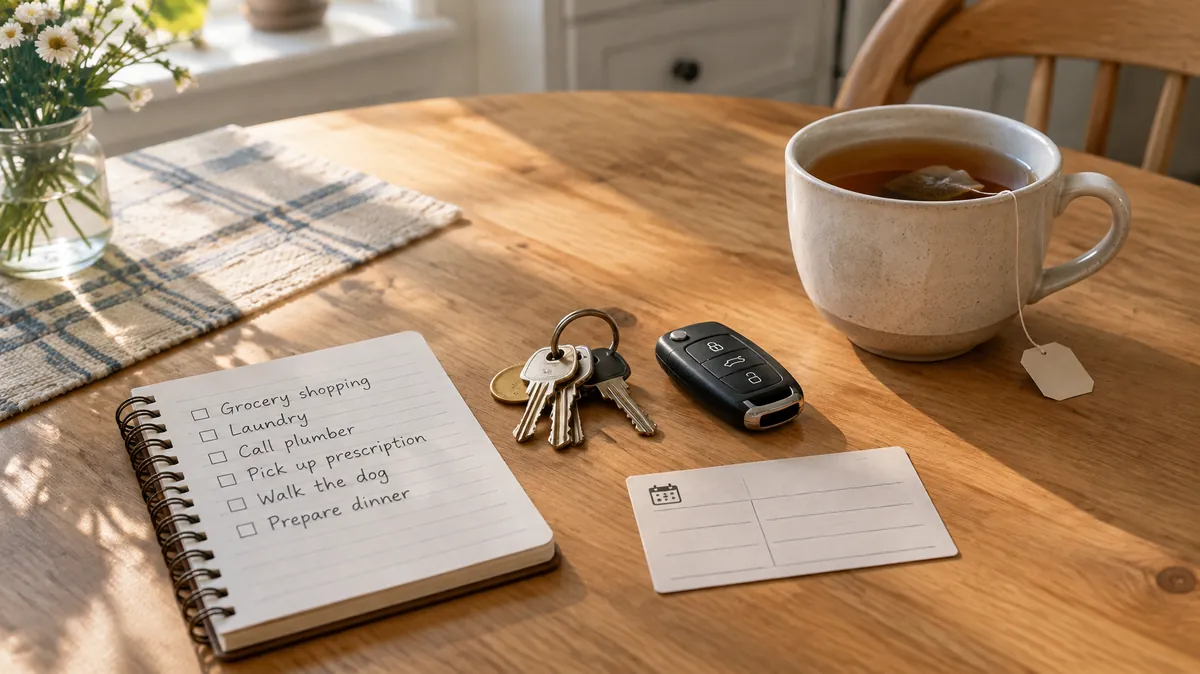
You drive your mother to her appointments. You sort her pills into a box on Sunday. You pay her bills, call the pharmacy, and check your phone at work in case she calls. If someone asked what you do, you would probably say “I’m her daughter.”
That is also caregiving. And if you do not use the word, you are in large company. Caregiver Action Network’s 2026 overview for National Family Caregivers Month, citing AARP, says about 40 percent of caregivers do not identify as caregivers.
The short answer
If you regularly help an older relative or friend with daily life, such as medications, appointments, meals, money, transportation or personal care, you are a family caregiver. There is no minimum number of hours, no need to live together, and no need for a diagnosis. Naming it matters because services and support are usually described in those terms.
Why does the word matter?
November is National Family Caregivers Month. The 2026 theme, “Care Connects Us,” marks its 29th year, according to Caregiver Action Network. The same overview says 78 percent of caregivers need more help finding information about support and services, citing NAC and AARP.
Those two numbers are connected. Programs for caregivers, such as respite care, caregiver training and support groups, are usually described to people who know they are caregivers. If you do not see yourself in the description, you may never look for them.
Signs you are already a caregiver
You do not need to do everything on this list. If several sound familiar, the word probably fits.
- You manage medications: filling the pill box, picking up refills, or checking that doses were taken.
- You handle appointments: booking them, driving, sitting in the room, or asking the questions afterward.
- You run the household tasks: shopping, meals, laundry, cleaning, yard work or home repairs.
- You deal with money and paperwork: paying bills, sorting insurance letters, or helping with forms.
- You help with personal care: bathing, dressing, toileting or getting in and out of a chair.
- You are the one they call: first for a fall, a scare, a question, or just to know someone is there.
- You plan around them: your work hours, trips and evenings bend around what they need.
- You coordinate from far away: you arrange services, call the doctor and check in daily from another city or state.
If you live far away, see our guide to long-distance caregiving. If your parent lives alone, see how to tell whether it is still safe.
What to do once you say it out loud
- Find your local Area Agency on Aging. The Eldercare Locator is free and can be reached at 1-800-677-1116. Ask what caregiver support, respite and home services exist in your parent’s county.
- Write down what you actually do in a week. A short list shows what you carry and what could be shared or handed off.
- Ask for one specific thing from one specific person. “Can you take Tuesday’s appointment?” is easier to say yes to than “I need more help.”
- Get the basics in one place. Our free Home Safety Checklist is a good first step, and our guide to what to put in a caregiver binder shows what to collect. If you want everything organized in one system, the Caregiver Command Center is our paid option.
- Watch your own limits. See caregiver burnout signs for what to look for before you are worn out.
If money is part of it, our guides cover what Medicare covers and where help paying for home changes can come from.
How we handle this guide
AgingSteady earns a commission on some links, which is explained in our affiliate disclosure. This guide links to no product seller. It is general information, not medical, legal or financial advice.
Get the Free Home Safety Checklist
A printable room-by-room checklist for bathrooms, bedrooms, kitchens, stairs and hallways.
Common questions
What counts as being a family caregiver?
A family caregiver is someone who helps a relative or friend with daily life because of age, illness or disability, usually without pay. That can mean help with personal care such as bathing and dressing, or with practical tasks such as managing medications, driving to appointments, handling bills, shopping, meals and housework. It also includes the planning and phone calls done from a distance. There is no minimum number of hours.
Do I have to live with my parent to be a caregiver?
No. Many caregivers live across town or in another state and still coordinate appointments, pay bills, arrange services and check in daily. Our guide to long-distance caregiving covers how to do that without being there.
Why do so many caregivers not call themselves caregivers?
Caregiver Action Network's 2026 National Family Caregivers Month overview, citing AARP, says about 40 percent of caregivers do not identify as caregivers. We found no single published reason. Many people see the work as part of being a daughter, son, spouse or friend, so the word never comes up.
Where do I find help once I realize I am a caregiver?
Start with the Eldercare Locator, a free service of the Administration for Community Living, which connects you to your local Area Agency on Aging (1-800-677-1116). Those agencies can explain local services such as respite, meal delivery, transportation and caregiver support. Your parent's doctor and their health plan are other starting points.
Is caregiving the same as being a care manager or having power of attorney?
No. Caregiving describes the help you give. Legal authority to make financial or medical decisions comes from documents such as a power of attorney or health care proxy, which your parent has to sign while they are able to. See our guide to talking to a parent about power of attorney.
Sources
Caregiver Action Network, 2026 National Family Caregivers Month Partner Overview (theme, 29th year, and the 40 percent and 78 percent figures, which CAN attributes to AARP and NAC; we did not review the underlying AARP and NAC reports). · Administration for Community Living, Eldercare Locator. We welcome corrections through our contact page.