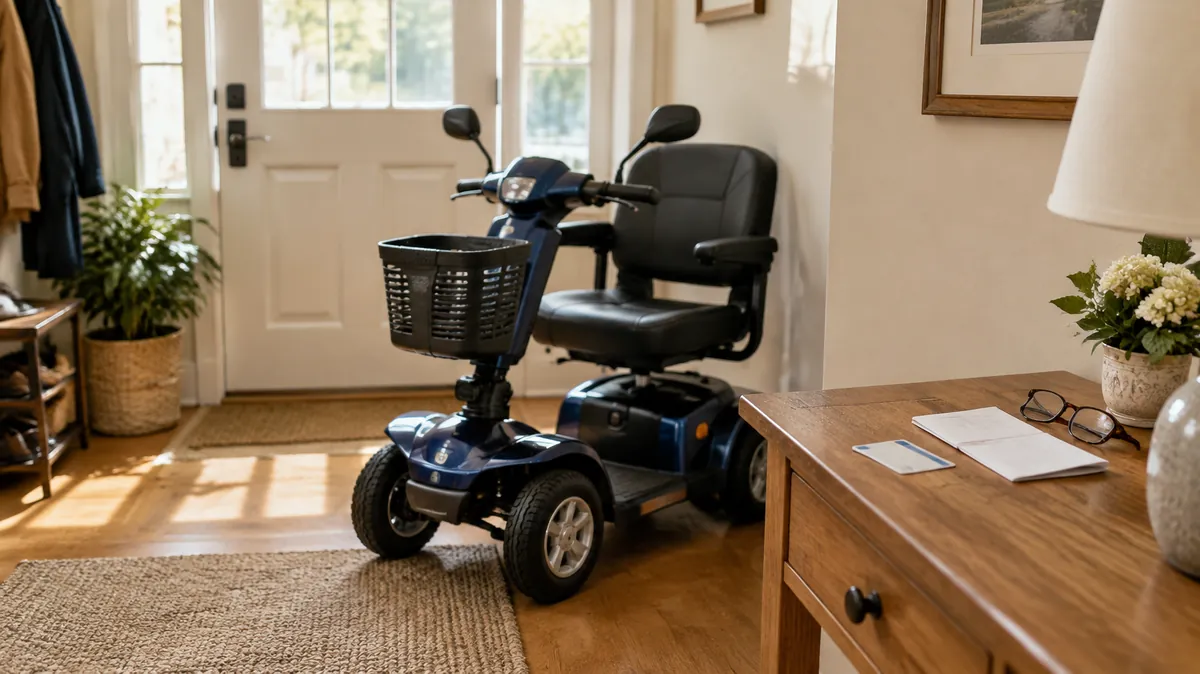
When walking gets harder, a mobility scooter looks like the obvious fix, and many families assume Medicare pays for one. It can, but the rules are specific and based on need inside the home, not on how far your parent wants to travel. Many people who want a scooter for outings do not meet the test.
This guide explains what Medicare.gov and CMS say, the steps a family has to get right, what you would pay, and what to look at if you buy one without Medicare. We are an independent research site, not Medicare counselors, and nothing here is personal advice.
The short answer
Original Medicare Part B: can cover a scooter if it is medically necessary, with a face-to-face exam, a written order and an enrolled supplier. You pay 20% after the deductible. The tests focus on need inside the home, and a cane or walker has to be unable to solve the problem.
In this guide
What Part B covers
Medicare.gov says Part B covers wheelchairs and power-operated vehicles (scooters) if you are eligible. The scooter has to be medically necessary. You need a face-to-face exam and a written prescription from a treating provider, and doctors and suppliers must be enrolled in Medicare and accept assignment. It is covered as durable medical equipment, so it has to be for a medical reason and used in the home.
Some power wheelchairs need prior authorization, and Medicare.gov says the supplier usually submits that request. A denial can happen if Medicare decides the device is not medically required or does not get enough information.
The tests CMS uses
CMS publishes guidance for suppliers on power mobility devices. It describes the in-home need your parent’s records have to show:
- A mobility limitation that significantly impairs daily activities in the home, such as toileting, eating, dressing, grooming or bathing.
- The limitation cannot be sufficiently and safely resolved using a cane or walker.
- The person cannot self-propel an optimally configured manual wheelchair at home, and no willing and able caregiver can push them.
- The person can safely operate the device and get on and off it.
- The home has adequate access between rooms, room to maneuver and suitable surfaces.
If your parent can still get around the house with a rollator, that is usually the starting point. Our guide to rollators and what to do when a parent refuses a walker cover that stage.
The steps, in order
Share or embed
Free to use with a credit link to this page.
<a href="https://www.agingsteady.com/does-medicare-cover-mobility-scooters"><img src="https://www.agingsteady.com/img/info/medicare-scooter-steps.png" alt="Five steps for a Medicare-covered scooter: a face-to-face visit within 6 months before the order, a written order within 6 months of the visit and before delivery, a home assessment, prior authorization where required, and an enrolled supplier. You pay 20 percent after the Part B deductible." width="1200" height="675"></a>
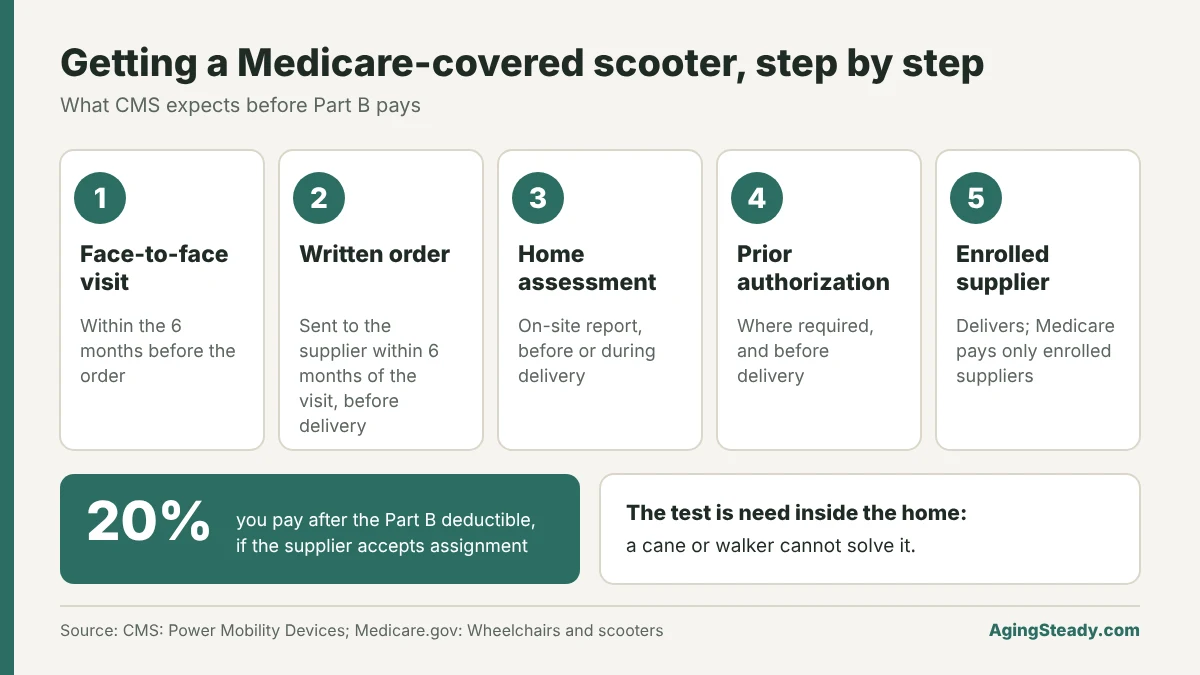
- A face-to-face visit. CMS says it must happen within the 6 months before the order, and should include a mobility exam and an assessment of daily activities. It can be in person or by qualifying telehealth.
- A written order. CMS says the practitioner sends a prescription to the supplier within 6 months of the visit and before delivery. The practitioner who wrote it must be the one who did the visit.
- A home assessment. CMS says an on-site assessment and written report are required, done by the practitioner or the supplier, to confirm the device can be used safely given doorways, thresholds and surfaces.
- Prior authorization, where it applies. CMS says that if it is required and not obtained before delivery, the claim is denied.
- An enrolled supplier. Medicare.gov says Medicare pays only for equipment from suppliers enrolled in Medicare.
CMS also notes that these devices have a high improper payment rate, so suppliers are told to check records for completeness before they submit a claim. In practice that means a good supplier will ask your parent’s doctor for a lot of paperwork. That is normal.
What you pay
Medicare.gov says that after the Part B deductible, you pay 20% of the Medicare-approved amount if the supplier accepts assignment. A supplier that does not accept assignment may charge more. Depending on the item, you may have to rent it, have to buy it, or be able to choose, and some rented items become yours after a set number of payments. We do not quote a price for a scooter because it varies by model and supplier, so ask for the Medicare-approved amount in writing.
Other ways to pay
- Medicare Advantage. The plan must be checked directly, because extra benefits differ. Look at the Evidence of Coverage and Annual Notice of Change; see our guide to reading the 2027 Annual Notice of Change.
- Medicaid. Some state waiver programs cover home supports for people who qualify, and what they include varies. Ask the state office or the caseworker.
- Local agencies. The Eldercare Locator (1-800-677-1116) can point you to local agencies that may know of help in your area.
- A free counselor. A SHIP counselor at shiphelp.org can explain the coverage for your parent’s plan.
If you buy one yourself
If your parent does not meet the in-home test, or wants a scooter mainly for outings, you will probably pay yourself. These questions are our own suggestions:
- What weight is it rated for, and is the seat comfortable for the length of trips your parent will take?
- How far does a full battery go, and how long does it take to charge?
- Will your parent be able to get on and off safely, and use the controls with their grip and vision?
- If it has to go in a car, how heavy is the heaviest piece when it comes apart, and who will lift it?
- Will it turn in your parent’s hallways, and does it fit through the doors it needs to?
- What is the warranty on the battery and motor, and who services it?
Folding and lightweight mobility scooters
A folding or lightweight model can be easier to transport but is usually less stable on rough ground. Check what your parent will use it for before choosing a size.
A scooter does not help at the front door. If steps are the problem, see our guides to wheelchair ramps for home and stairlift alternatives.
Get the Free Home Safety Checklist
A printable room-by-room checklist for bathrooms, bedrooms, kitchens, stairs and hallways.
Common questions
Does Medicare cover mobility scooters?
Sometimes. Medicare.gov says Part B covers wheelchairs and power-operated vehicles (scooters) if you are eligible. The scooter must be medically necessary, and you need a face-to-face exam and a written prescription from a treating provider.
How much does Medicare pay for a mobility scooter?
Medicare.gov says that after you meet the Part B deductible, you pay 20 percent of the Medicare-approved amount if the supplier accepts assignment. A supplier that does not accept assignment may charge more.
Does Medicare cover a scooter for use outside the home?
The coverage tests in CMS guidance are about mobility inside the home. A limitation that a cane or walker cannot solve, and that gets in the way of daily activities such as toileting, dressing and bathing, is what CMS looks for. Ask the doctor and the supplier how your parent's situation fits.
Can I buy a scooter online and ask Medicare to reimburse me?
Medicare.gov says Medicare pays for equipment only from suppliers enrolled in Medicare. Check that the supplier is enrolled and accepts assignment before you order.
Does a scooter need prior approval?
CMS says that when prior authorization is required for a power mobility device and is not obtained before delivery, the claim is denied. Medicare.gov says the supplier usually submits the request.
Are ads offering a free mobility scooter real?
Be cautious. Medicare requires a medical need, an exam, a written order and an enrolled supplier. An offer that skips those steps is not following the rules described on Medicare.gov and CMS pages.
One important caveat
This guide is general information for caregivers and is not medical, legal, tax or financial advice. Medicare rules, plan benefits and prices change and differ by plan and area. For decisions about your parent’s coverage, talk with the plan, a SHIP counselor or Medicare directly. We are not affiliated with any plan or supplier, and we earn nothing from plan enrollments.
Sources
Medicare.gov, Wheelchairs and scooters coverage and Durable medical equipment (DME) coverage (eligibility, exam and prescription, prior authorization, enrolled suppliers, the 20% share; neither page shows a date). CMS, Power Mobility Devices (the face-to-face visit, the written order, the in-home need tests, the home assessment and prior authorization; written for suppliers and practitioners). Medicaid.gov, home and community-based services. Administration for Community Living, Eldercare Locator. We opened each of these in October 2026. The questions and steps are our own suggestions. We welcome corrections through our contact page.