
A lift chair looks like a recliner that helps a person stand. Families often ask whether Medicare pays for one after a hip or knee problem makes the couch or armchair a daily struggle. The honest answer has two parts. Medicare can cover the lifting mechanism under strict medical rules. It does not appear to cover the chair itself.
This guide sorts what the official policies say, what the rules mean in practice and what to ask before you spend money. We are an independent research site, not Medicare counselors, and nothing here is personal advice. Rules and plan benefits change.
The short answer
Original Medicare: may cover the lift mechanism, not the chair, and only if four medical criteria are met. Medicare Advantage and Medicaid: depends on the plan or state. Finding it hard to stand up does not meet the test on its own, because the policy requires being entirely unable to rise from an ordinary armchair.
In this guide
What Medicare actually covers
Medicare.gov says Part B covers durable medical equipment when it is used for a medical reason, used in the home, expected to last at least three years, ordered by a doctor or other provider and supplied by a Medicare-enrolled supplier. A lift chair can fit that description, but the details matter.
The CMS billing article for seat lift mechanisms says these mechanisms are covered under the durable medical equipment benefit. It does not state coverage for the chair itself. When a lift is built into a chair at purchase, the article says the lift mechanism is billed on its own and the chair is billed separately. In plain terms, Medicare’s coverage is about the lift, not the furniture around it. Ask the supplier to write down which part of the price Medicare would pay, and which part you would.
The four medical criteria
Share or embed
Free to use with a credit link to this page.
<a href="https://www.agingsteady.com/does-medicare-cover-lift-chairs"><img src="https://www.agingsteady.com/img/info/lift-chair-four-criteria.png" alt="Four medical criteria for a Medicare-covered seat lift: severe hip or knee arthritis or a severe neuromuscular disease; part of the treatment plan; entirely unable to stand from any chair at home; able to walk once standing. All four must be true, and coverage is for the lift mechanism, and the chair is billed separately." width="1200" height="675"></a>
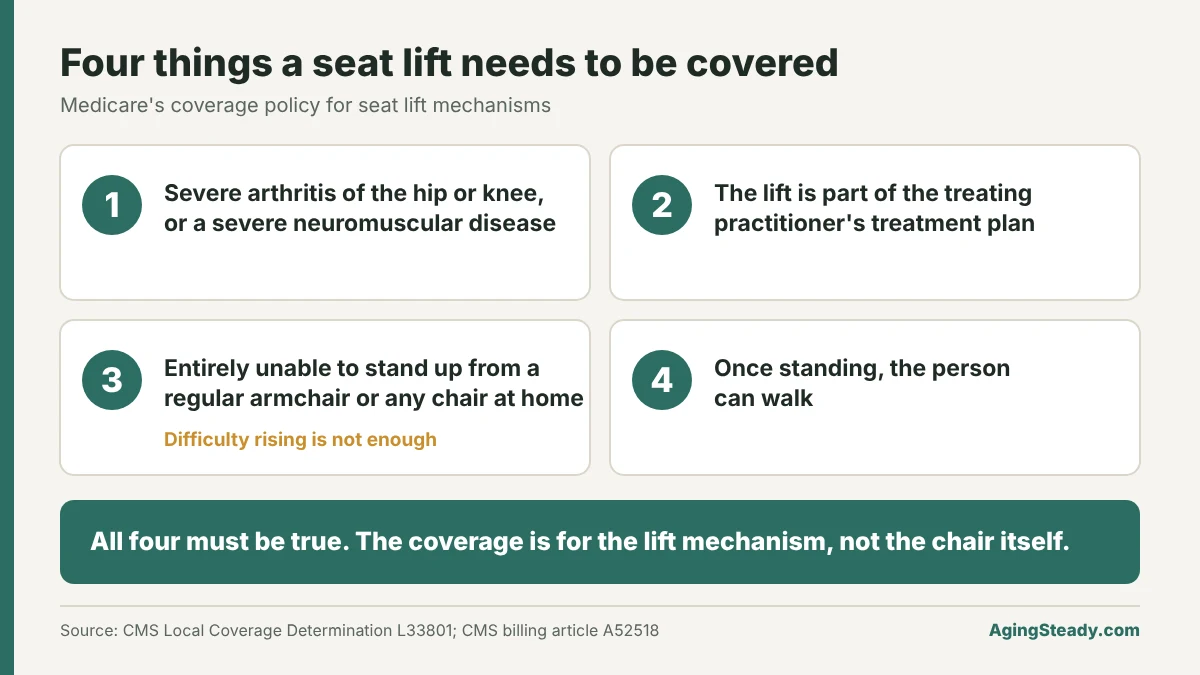
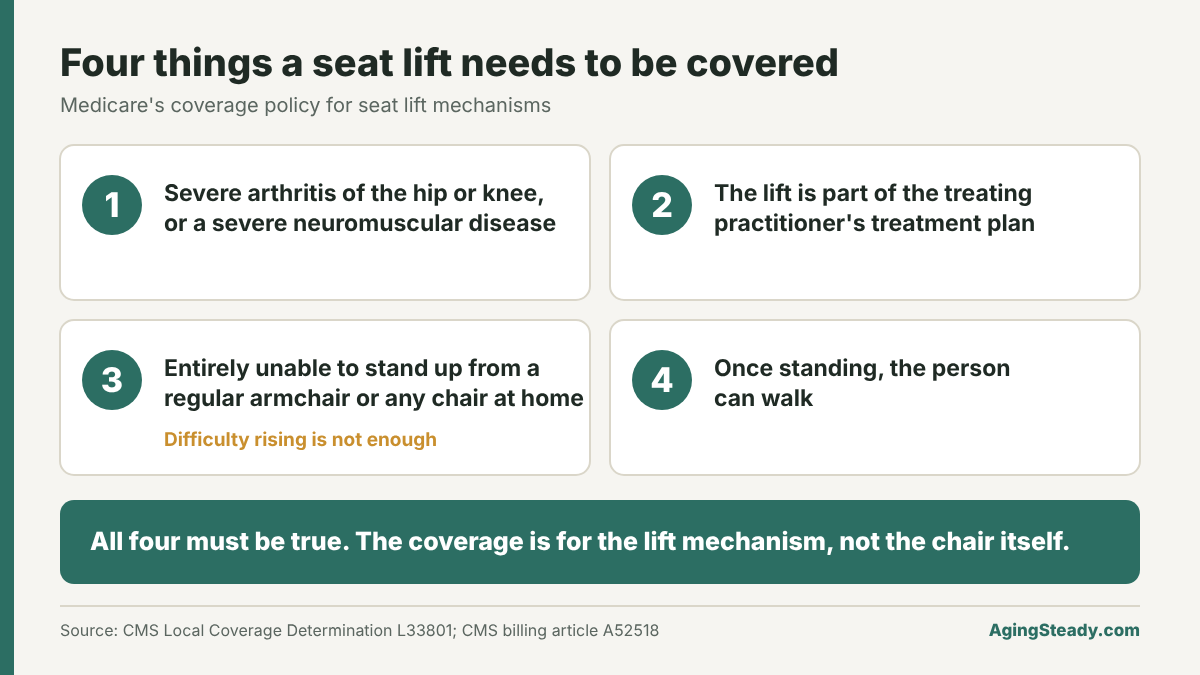
The CMS coverage policy for seat lift mechanisms says a lift is covered only if all four of these are true:
- The person has severe arthritis of the hip or knee, or a severe neuromuscular disease.
- The lift is part of the treating practitioner’s treatment plan and is prescribed to improve the condition or slow its decline.
- The person is entirely unable to stand up from a regular armchair or any chair at home. The policy says difficulty rising, even from a low chair, is not enough.
- Once standing, the person can walk.
The policy also says the lift has to operate smoothly, be controlled by the person and help them stand and sit without other assistance. Spring-release lifts that launch the user abruptly from sitting to standing are excluded.
The third point is where most families are surprised. A parent who is slow, unsteady or in pain when standing may still be able to rise from a firm armchair, and that is exactly the case the policy rules out. If your parent is falling, that is a separate safety problem; see our guide to what to do when an elderly parent keeps falling.
How the order and approval work
- The CMS policy says the ordering practitioner must be the treating practitioner, or a consultant, for the condition causing the need.
- The records must show that appropriate therapies, such as medication or physical therapy, were tried and did not let the person rise from a chair.
- The CMS billing article says some items need a face-to-face visit and a written order before delivery, and that a late order does not fix a denial. Ask the supplier whether a seat lift is on that list and get the order first, before the chair arrives.
- Medicare.gov says Medicare pays only for equipment from suppliers enrolled in Medicare. Ask before you order whether the supplier is enrolled and accepts assignment.
What you pay
Medicare.gov says that after the Part B deductible, you pay 20% of the Medicare-approved amount if the supplier accepts assignment. A supplier that does not may charge more. Depending on the item, you may have to rent it, have to buy it, or be able to choose. We do not quote lift chair prices here because they vary widely by model and we have no single trusted source, so get written quotes that separate the lift from the chair.
Other ways to pay
- Medicare Advantage. Plans can offer extra benefits, but it depends on the plan. Look in the Evidence of Coverage and the Annual Notice of Change, or call member services. Our guide to reading the 2027 Annual Notice of Change shows what to look for, and open enrollment runs October 15 to December 7.
- Medicaid. Programs are run by each state, and some home and community-based services waivers cover home supports for people who qualify, and what they include varies. Ask the state office or caseworker.
- Local help. The Eldercare Locator (1-800-677-1116) connects families to local Area Agencies on Aging.
- A free counselor. A SHIP counselor at shiphelp.org can explain your parent’s coverage and does not sell plans.
If you buy one yourself
Many families pay for a lift chair themselves, because the medical test is narrow. These questions are our own suggestions, not a rating of any product:
- What weight and height is the chair rated for, and does the seat depth suit your parent’s legs?
- What happens in a power cut? Ask whether there is a battery backup, and how the chair lowers without power.
- Does it lift smoothly, with a simple hand control that your parent can find and use?
- What is the warranty on the motor, and who repairs it?
- What is the return policy if the chair does not fit your parent after a week?
- Will it fit through the doors and into the room, with space behind it to recline?
Lift chair recliners
If your parent does not meet the Medicare test, a retail lift recliner can still help with standing. Measure the room and your parent first, and have them sit in one before you commit if you can.
What to do, in order
- Ask your parent’s doctor whether they could rise from an ordinary armchair, and whether they meet the four criteria.
- If a doctor thinks they might, ask for an order and talk to a Medicare-enrolled supplier before buying.
- Ask the supplier which part of the price is the lift and which is the chair.
- Check the plan, Medicaid or local help if your parent has any of those.
- If Medicare will not pay, compare retail options on weight rating, backup power, warranty and returns.
- If your parent is also falling, deal with that first. Our home fall risk checklist is a good place to start.
Get the Free Home Safety Checklist
A printable room-by-room checklist for bathrooms, bedrooms, kitchens, stairs and hallways.
Common questions
Does Medicare pay for a lift chair?
Medicare may help with the seat lift mechanism, not the whole chair. CMS lists seat lift mechanisms under the durable medical equipment benefit, and its billing article does not state coverage for the chair itself. The lift also has to meet four medical criteria.
What are the Medicare requirements for a seat lift mechanism?
Under the CMS coverage policy, the person must have severe arthritis of the hip or knee or a severe neuromuscular disease, the lift must be part of the treatment plan, the person must be entirely unable to stand up from a regular armchair or any chair at home, and once standing the person must be able to walk.
My parent has trouble getting up from chairs. Does that qualify?
Not on its own. The CMS policy says difficulty rising, even from a low chair, is not enough. Most people who can walk can get out of an ordinary chair of suitable height that has arms.
Does a doctor have to order it?
Yes. The ordering practitioner must be the treating practitioner or a consultant for the condition causing the need, and the records must show that therapies such as medication or physical therapy were tried and did not let the person rise from a chair.
Does Medicare cover a lift that sits on a toilet?
No. The CMS billing article says a seat lift mechanism placed over or on top of a toilet is non-covered.
Will a Medicare Advantage plan pay for a lift chair?
Plans differ, and extra benefits change every year. Ask the plan directly and check the Evidence of Coverage and Annual Notice of Change rather than assuming.
One important caveat
This guide is general information for caregivers and is not medical, legal, tax or financial advice. Medicare rules, plan benefits and prices change and differ by plan and area. For decisions about your parent’s coverage, talk with the plan, a SHIP counselor or Medicare directly. We are not affiliated with any plan or supplier, and we earn nothing from plan enrollments.
Sources
Medicare.gov, Durable medical equipment (DME) coverage (what qualifies, the order and supplier rules, the 20% share; the page shows no date). CMS Medicare Coverage Database, billing and coding article A52518, Seat Lift Mechanisms (covered under the DME benefit; chair billed separately; toilet lifts non-covered; order timing) and Local Coverage Determination L33801 (the four criteria and the ordering rules). Medicaid.gov, home and community-based services. Administration for Community Living, Eldercare Locator. We opened each of these in October 2026. The questions and steps are our own suggestions. We welcome corrections through our contact page.