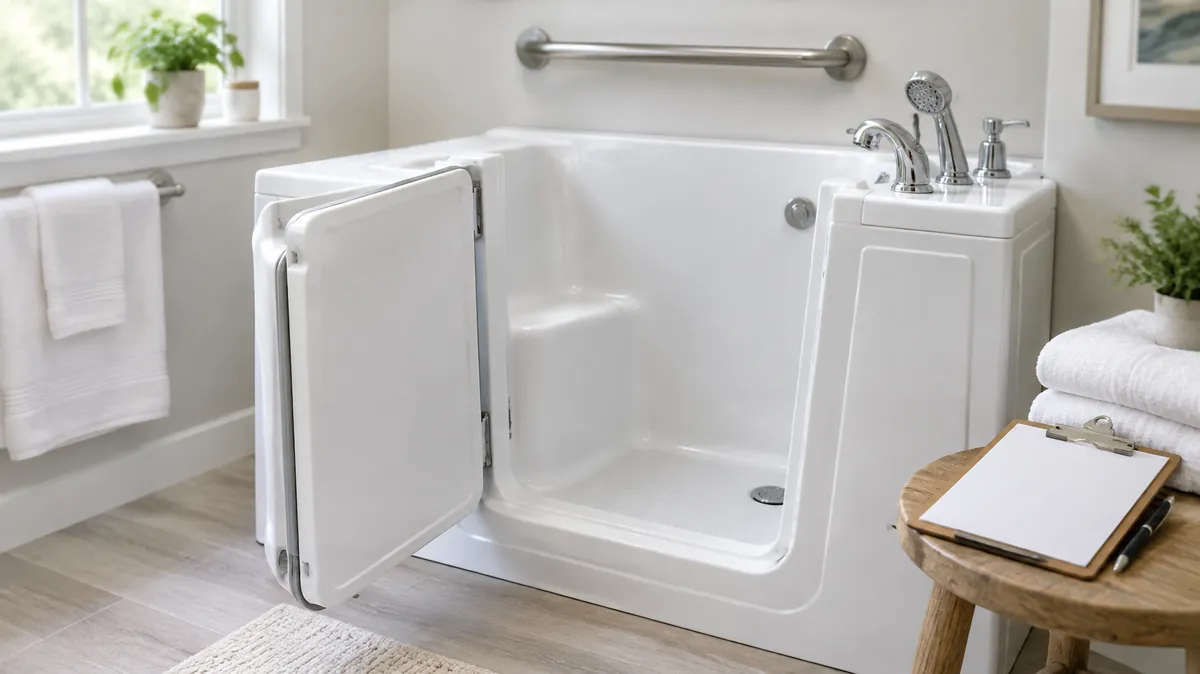
A walk-in tub is a major purchase, and families often assume Medicare will help. In most cases it will not. There are other routes, and cheaper ways to make the bathroom safer, that are worth looking at before you sign anything.
This guide goes through what the official sources say, who might help pay, and the questions to ask any company. We are an independent research site, not Medicare counselors, and nothing here is personal medical, legal or tax advice.
The short answer
Original Medicare: generally no. Medicare Advantage: some plans may help, with limited allowances. Medicaid, the VA and the tax rules: sometimes, depending on your parent’s situation. A walk-in shower or other bathroom changes can cost less and may fit better. Ask before you sign.
In this guide
Original Medicare
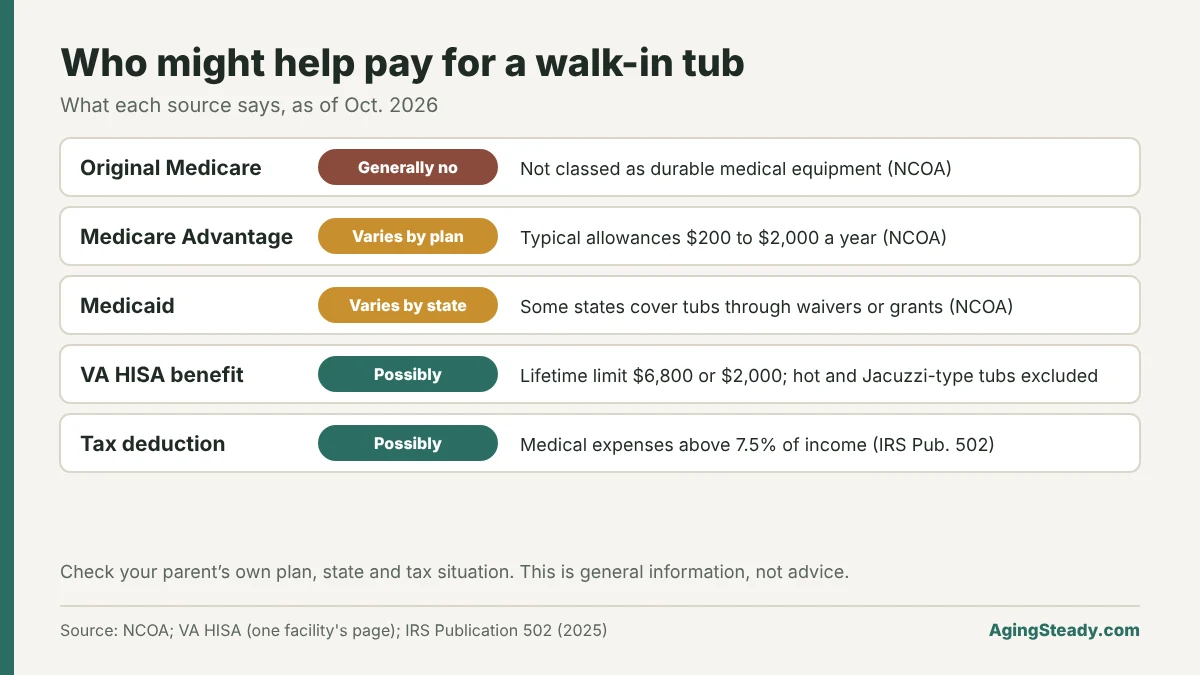
NCOA says Original Medicare (Parts A and B) generally does not classify walk-in tubs as durable medical equipment. That fits the rules on Medicare.gov: Part B covers durable medical equipment that is used for a medical reason, used in the home and ordered by a doctor. A walker is that kind of item. A bathtub, even one made for older adults, generally is not treated the same way. Medigap does not change that, because it only helps with costs that Original Medicare already covers.
Medicare Advantage
NCOA says some Medicare Advantage plans may partly cover a walk-in tub if a doctor prescribes it as medically necessary, with allowances that it describes as typically $200 to $2,000 per year. That is a small share of the cost. Whether your parent’s plan has the benefit is in the Evidence of Coverage and the Annual Notice of Change, or you can ask member services. Our guide to reading the 2027 Annual Notice of Change shows what to look for, and open enrollment runs October 15 to December 7.
Medicaid and the VA
- Medicaid. NCOA says some states cover tubs through waiver programs or grants, often with a doctor’s note, an occupational therapist’s recommendation or proof of medical necessity. Programs are run by each state; see Medicaid.gov’s overview of home and community-based services, and use the Eldercare Locator (1-800-677-1116) to reach your local Area Agency on Aging.
- The VA. The HISA benefit helps eligible veterans pay for medically necessary changes to the primary home. One VA facility’s page lists bathroom changes such as roll-in showers as covered, and hot tubs and Jacuzzi-type tubs as excluded. It gives lifetime limits of $6,800 for a service-connected disability (or for a non-service-connected one if the veteran is rated at least 50 percent service-connected) and $2,000 for others. That is one facility’s description, so ask your local Prosthetic and Sensory Aids Service what applies.
Share or embed
Free to use with a credit link to this page.
<a href="https://www.agingsteady.com/does-medicare-cover-walk-in-tubs"><img src="https://www.agingsteady.com/img/info/walk-in-tub-who-might-help.png" alt="Who might help pay for a walk-in tub: Original Medicare generally no; Medicare Advantage varies, typically $200 to $2,000 a year; Medicaid varies by state; VA HISA possibly, up to $6,800 or $2,000 lifetime; tax deduction possibly, above 7.5 percent of income." width="1200" height="675"></a>
The tax rules
IRS Publication 502 says you can deduct only the part of medical and dental expenses above 7.5% of your adjusted gross income. It also says special equipment or improvements installed mainly for medical care can count as medical expenses, and that accessibility changes such as entrance ramps, widened doorways, bathroom railings and grab bars usually do not raise the value of a home, so their full cost can generally be included. The publication warns that only reasonable costs to accommodate a disabled condition count as medical care. It does not name walk-in tubs in the part we read, so ask a tax professional whether your situation qualifies. NCOA also says an FSA or HSA may be usable with a doctor’s letter.
What it costs
Share or embed
Free to use with a credit link to this page.
<a href="https://www.agingsteady.com/does-medicare-cover-walk-in-tubs"><img src="https://www.agingsteady.com/img/info/walk-in-tub-cost-range.png" alt="Walk-in tub costs: new tubs about $2,500 to $17,000 including installation; used tubs about $200 to $3,000 or more. A Medicare Advantage allowance, where offered, is typically $200 to $2,000 a year." width="1200" height="675"></a>
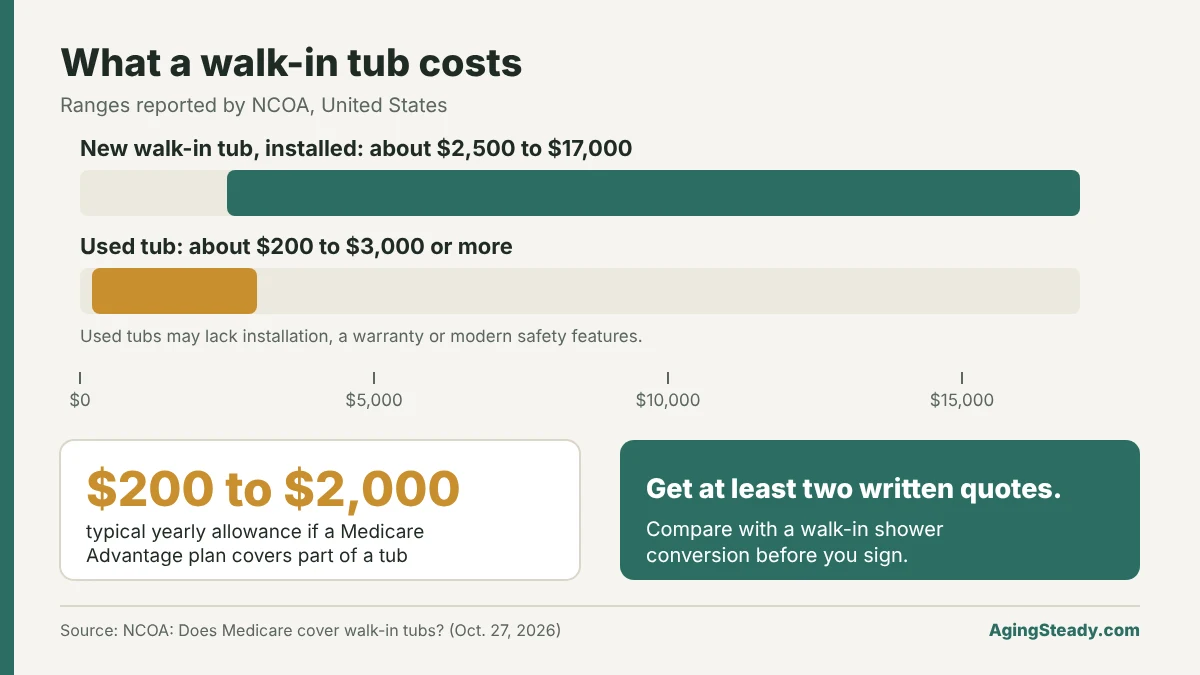
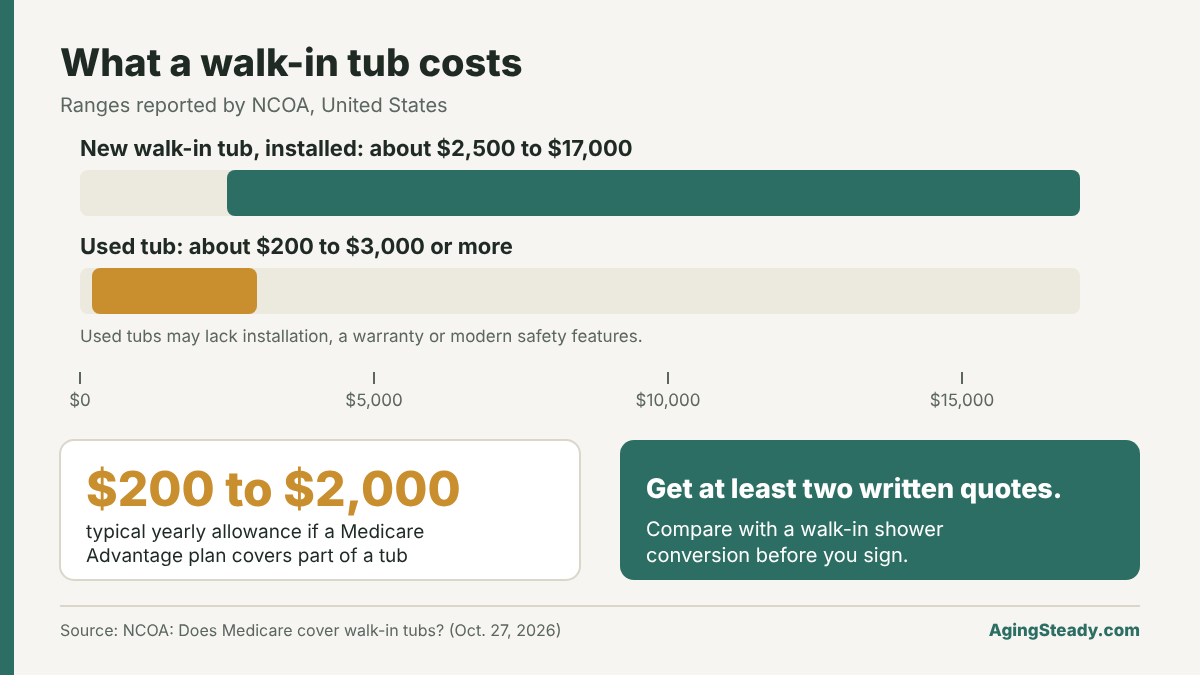
NCOA gives these ranges: new walk-in tubs about $2,500 to $17,000 including installation, and used tubs about $200 to $3,000 or more, though used tubs may lack installation, a warranty or modern safety features. The gap between those numbers is the reason to get at least two written quotes. We have not tested or priced any tub ourselves.
Questions to ask any company
These are our own suggestions. A tub is a big commitment for a person who may already feel unsteady:
- What is the total price installed, including plumbing, electrical work and removal of the old tub, in writing?
- How long does the tub take to fill and to drain, and where does the bather wait?
- Can my parent get in, sit down and get out again unaided, and will the seat height and door width suit them?
- Does my parent’s water heater supply enough hot water to fill it?
- What is the warranty on the door seal, the pump and the finish, and who services it near us?
- Is there a cancellation window, and is the price good only if I sign today?
- Can I see the quote broken down so I can compare it with a walk-in shower?
Take the quote home, and have a doctor or occupational therapist weigh in on whether a tub is the right fit for your parent’s balance, strength and any plans for care.
Cheaper options
If your parent’s main risk is stepping over the tub wall, a full tub may be more than the problem needs. Compare these, starting with the cheapest:
- Grab bars, a bath mat and a shower chair or transfer bench. Our bathroom safety checklist and our guide to grab bars cover placement, which matters more than the product.
- A walk-in or roll-in shower conversion. This removes the step and is the kind of bathroom change the VA lists as eligible. Get quotes and ask about drainage and flooring.
- A walk-in tub. Worth considering if your parent likes to soak and can manage the fill and drain time safely.
Shower chair with back
A sturdy shower chair lets your parent sit while washing and avoids standing on a wet floor. Check the weight rating and that the feet grip your tub or shower floor.
Get the Free Home Safety Checklist
A printable room-by-room checklist for bathrooms, bedrooms, kitchens, stairs and hallways.
Common questions
Does Medicare pay for a walk-in tub?
Generally no. NCOA says Original Medicare generally does not classify walk-in tubs as durable medical equipment. Medicare.gov says durable medical equipment has to be used for a medical reason, used in the home and ordered by a provider.
Do Medicare Advantage plans cover walk-in tubs?
Some might. NCOA says some plans may partly cover a walk-in tub if a doctor prescribes it as medically necessary, with allowances that it describes as typically $200 to $2,000 per year. This varies by plan, so check the Evidence of Coverage and ask member services.
Can Medicaid pay for a walk-in tub or shower?
In some states. NCOA says some states cover tubs through waiver programs or grants, often with a doctor's note or an occupational therapist's recommendation. Ask the state Medicaid office or caseworker.
Does the VA help with a walk-in tub or shower?
Possibly. The VA's HISA benefit helps eligible veterans pay for medically necessary changes to the home, including bathroom changes such as roll-in showers. The VA's page for one facility lists hot tubs and Jacuzzi-type tubs as excluded, so ask the local Prosthetic and Sensory Aids Service what applies.
Is a walk-in tub tax deductible?
It may be, in some cases. IRS Publication 502 says special equipment or improvements installed mainly for medical care can be included in medical expenses, and that you can deduct only the part of total medical expenses above 7.5 percent of adjusted gross income. Ask a tax professional whether a specific tub or shower conversion qualifies.
Is a walk-in shower a cheaper option?
Often, but we have no single trusted price. Get at least two written quotes, and ask a doctor or occupational therapist what suits your parent's balance and strength.
One important caveat
This guide is general information for caregivers and is not medical, legal, tax or financial advice. Medicare rules, plan benefits and prices change and differ by plan and area. For decisions about your parent’s coverage, talk with the plan, a SHIP counselor or Medicare directly. We are not affiliated with any plan or supplier, and we earn nothing from plan enrollments.
Sources
NCOA, Does Medicare cover walk-in tubs? (Original Medicare, Medicare Advantage allowances, Medicaid, costs; the page is dated October 27, 2026). Medicare.gov, Durable medical equipment (DME) coverage (what qualifies; the page does not mention walk-in tubs and shows no date). VA, Home Improvements and Structural Alterations (HISA), one VA facility’s page. IRS, Publication 502, Medical and Dental Expenses (2025). Medicaid.gov, home and community-based services. Administration for Community Living, Eldercare Locator. We opened each of these in October 2026. The questions and steps are our own suggestions. We welcome corrections through our contact page.