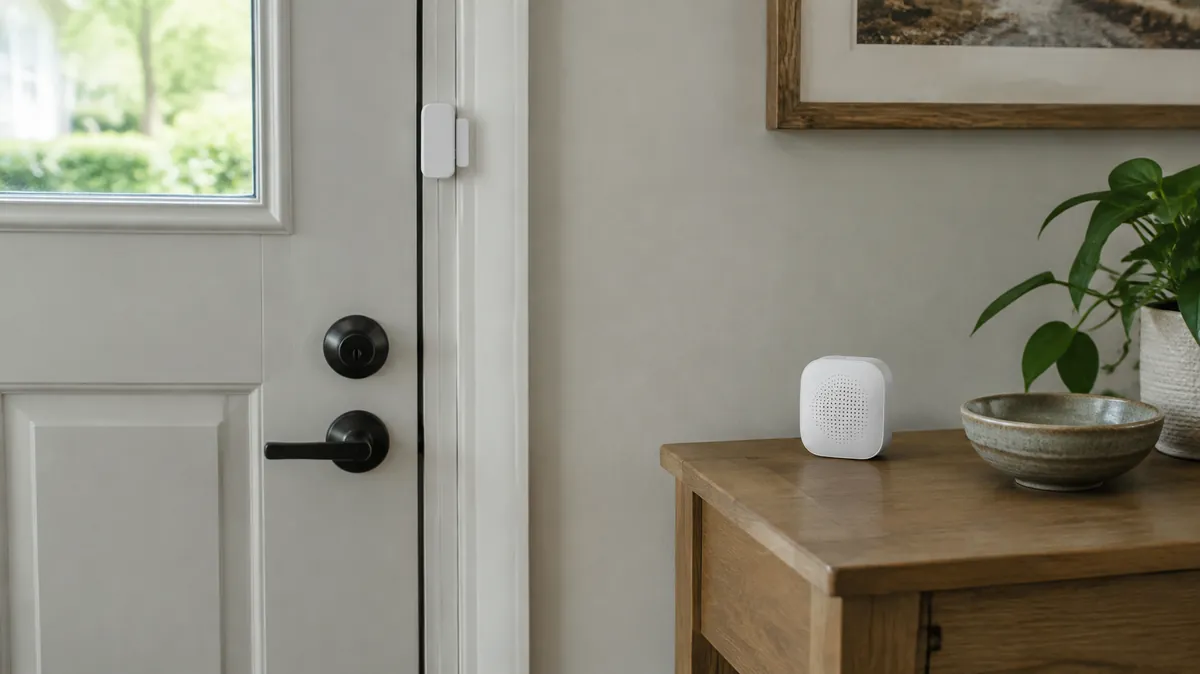
A door alarm tells you that a door has opened. For a parent with dementia who may try to leave the house, that can be the difference between noticing in seconds and noticing after they are down the street. It does not stop them, and it does not tell you where they went, so it works best as one part of a plan.
The Alzheimer’s Association says six in 10 people living with dementia will wander at least once, and many do so repeatedly. This guide covers the main types of door alarm, the safety rules around locks, and the questions worth asking before you buy. We have not tested any of these devices, and we do not name a product as the best.
In this guide
Safety first: alarms, locks and fire
People often reach for locks and alarms together. They are very different. An alarm adds nothing that can trap anyone. A lock can, and in a fire or other emergency a person who cannot get out, or a caregiver who cannot get to them, is in real danger.
What the guidance says about locks
The Alzheimer’s Association home safety checklist suggests placing deadbolts on exterior doors out of the person’s line of sight, high or low. In the same line it says to never lock a person in at home and not to leave someone unsupervised in new or changed surroundings. The National Institute on Aging says to keep the key nearby in case of an emergency, and advises against leaving a person with a history of wandering unattended. If you are unsure what is safe for your parent’s home, ask their doctor, or call the Alzheimer’s Association 24/7 Helpline at 800-272-3900.
This is a good reason to start with alarms and low-tech cues, and to make any lock decision separately and carefully. Mayo Clinic describes alarm mats, door bells and chimes, and childproof knob covers as options that alert you or discourage opening without locking anyone in.
The main types compared
These are typical descriptions of each type, not claims about any particular product.
| Type | How it works | Watch out for | Often suits |
|---|---|---|---|
| Warning bell above the door | A bell rings when the door swings open | Very simple, but only works if someone nearby hears it | A small home where the caregiver is always close |
| Door and window chime sensor | A magnet and sensor sound a chime or alarm when the door or window opens | Sound level matters. Check the gap size for sliding doors. | Most families, as a first step |
| Sensor with a portable receiver or pager | The sensor sends the alert to a receiver you carry or keep by your bed | Range through walls varies. Batteries in both parts need checking. | Larger homes, or caregivers who sleep in another room |
| App-connected smart sensor | Sends a notification to your phone, often through a hub and Wi-Fi | Depends on Wi-Fi, the app, and a phone that is on and nearby. Updates and logins still need attention. | Caregivers who can check a phone quickly, including from nearby buildings |
| Pressure mat in front of the door | Alerts when someone steps on the mat, before the door opens | A mat on the floor can be a trip hazard. It can also catch family members and pets. | Someone who always approaches the same door |
Which doors and windows should you cover?
Start with the exterior doors your parent has used or tried, including sliding doors and any door from the garage. Then consider ground-floor windows that open. The National Institute on Aging also suggests hardware that limits how far windows can open.
A bedroom door alarm is a different decision. It can tell you when someone has left their room at night, but it also watches a person in their own space, so think about privacy and dignity. For nighttime movement from the bed itself, see our bed alarms guide.
How does the alert reach you?
- A sound at the door. Simple, but a loud one can startle someone with dementia, and it only helps if you hear it.
- A receiver you carry or keep by your bed. It does not depend on Wi-Fi or your phone, which is why many caregivers prefer it for nights.
- A phone notification. Convenient when it works, but it depends on a working app, a connection, and a phone you will notice at 3 a.m.
The Alzheimer’s Association advises identifying the time of day your parent is most likely to wander and planning activities around it. For people who experience sundowning, that may begin in the early evening. Keep alarms armed overnight as well.
What should you ask before you buy?
- Who will hear it, and how fast can they get to the door? Be realistic about the middle of the night.
- Is the sound adjustable, or can the alert go to a receiver only? A harsh alarm may upset your parent.
- What is the range between the sensor and the receiver? Test it through the walls of your own home.
- Does it warn you when a battery is low? A dead sensor is worse than none, because it feels like protection.
- Will it fit your doors and windows? Check the gap size, especially for sliding doors.
- Can your parent turn it off or remove it? If so, where is it mounted and does it have a tamper alert?
- Does it need Wi-Fi or an app? If so, what happens when the connection drops?
- What is the return window? Many alarms are easy to try and send back.
What should you pair a door alarm with?
The Alzheimer’s Association lists many low-tech measures alongside alarms: cover door knobs with cloth the same color as the door or use safety covers, camouflage doors by painting them the wall color or hanging a removable screen, store coats, keys and other triggers out of sight, and use night lights throughout the home. It also advises planning ahead for a wandering emergency.
- A way to find your parent outside. A door alarm cannot do that. See our GPS tracker guide.
- An emergency profile. A recent close-up photo, a list of familiar places and key contacts, ready to hand to police. Our free Dementia Wandering Emergency Profile covers it.
- A wandering response service. The Alzheimer’s Association suggests considering one, and asking neighbors, friends and family to call you if they see your parent out.
- Supervision. No device replaces someone being there. Mayo Clinic advises making sure someone is home with the person at all times.
- The other devices. Our dementia monitoring guide compares door sensors, GPS and bed sensors, and our free device finder matches devices to the worry.
Where to compare options
We link to a search for each type below so you can see current options, prices and reviews. These are not recommendations of any specific product.
Door and window chime sensor
Door sensor with a portable receiver
Pressure mat alarm for a doorway
How we handle product links
AgingSteady earns a commission on some links, which is explained in our affiliate disclosure. We have not tested these devices ourselves, and the order of the options above has nothing to do with what we earn. Your local Area Agency on Aging or Alzheimer’s Association chapter can tell you whether any programs near you help with the cost of safety equipment.
Common questions
Do door alarms work for dementia wandering?
They do one job: they tell a caregiver that a door has opened, which buys time to step in. They do not stop someone from leaving, and they do not tell you where a person has gone. The Alzheimer's Association says its home-safety tips may reduce the risk of wandering but cannot guarantee that a person will not wander, so an alarm works best as one layer alongside supervision, a plan, and a way to locate or identify the person.
Should I lock the doors for a parent with dementia?
Locks are a separate decision from alarms and carry a real safety risk in an emergency such as a fire. The Alzheimer's Association checklist says to place deadbolts high or low, out of the person's line of sight, but also to never lock a person in at home and never leave them unsupervised in new or changed surroundings. The National Institute on Aging suggests keeping the key nearby in case of emergency. An alarm adds no lock, which is one reason many families start there. For advice on your parent's situation, ask their doctor or the Alzheimer's Association 24/7 Helpline at 800-272-3900.
What is the best door alarm for a person with dementia?
There is no single best one, and we have not tested any. What matters is the match: an alert that reaches a person who can respond within a minute or two, a sound that will not frighten your parent, and a range and battery setup you can rely on. A receiver you carry or keep next to your bed does not depend on Wi-Fi or a phone, while an app alert does, so think about which failure you can live with.
Will a door alarm scare someone with dementia?
It can. A sudden loud alarm may startle or upset some people, and a repeated one can make a home feel tense. If you can, choose a sound you can adjust or an alert that goes to the caregiver's receiver, and try it with your parent present so you can see how they react. Explain it at a level they can follow, and watch the first few days.
Which doors and windows should have an alarm?
Start with the exterior doors your parent has used or tried, including sliding and garage-entry doors, then any ground-floor windows that open. A bedroom door alarm is another option if you want to know when someone leaves their room at night, but think about privacy and dignity before adding one. The National Institute on Aging also suggests safety devices that limit how far windows open.
What should I do if the alarm goes off and my parent is gone?
Start searching immediately. The Alzheimer's Association advises looking close by first, since many people who wander are found within about 1.5 miles of where they went missing, and checking nearby ponds, tree lines and fence lines. If the person is not found within 15 minutes, it advises calling 911 and telling the authorities that the person has dementia. Having a recent close-up photo and a list of familiar places ready makes this faster. Our free wandering profile helps you prepare both.
One important caveat
This guide is general information for caregivers and is not medical or safety-engineering advice. Decisions about locks, supervision and your parent’s care should involve their doctor and, where relevant, your local fire department or Alzheimer’s Association chapter.
Sources
Alzheimer’s Association, Wandering and Dementia (we read the full page in October 2026; the statistic, home safety checklist and search guidance come from it). · National Institute on Aging, Coping With Alzheimer’s Behaviors: Wandering and Getting Lost (we could not open this page directly and rely on its indexed text for the points attributed to it). · Mayo Clinic, Alzheimer’s and dementia: Understand wandering and how to address it (also read from its indexed text; this is an older article). Type descriptions are general and not tied to any product, and we have not checked them against manufacturer specifications. We welcome corrections through our contact page.