
Often one sibling does most of the caregiving while the others are far away, busy or silent. A family meeting gets everyone looking at the same facts and puts the tasks in writing. It will not fix old family arguments. It can still stop the work from landing on one person by default.
This page gives you a free two-page agenda and task sheet, and summarizes advice from Family Caregiver Alliance, DailyCaring, Michigan State University Extension and VNS Health, named where they are used. We are an independent research site. The PDF is ours. It comes from the same family as our paid Caregiver Command Center, which you do not need to buy.
Download the free PDF
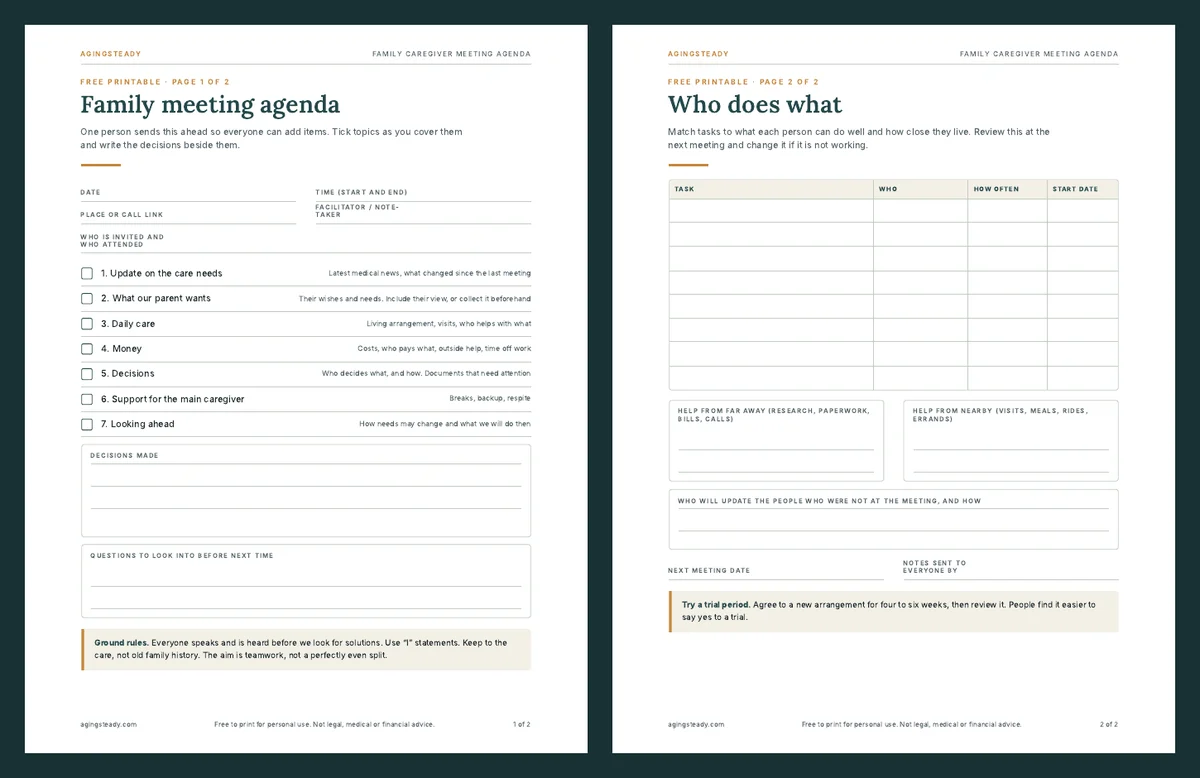
Two pages, US Letter: an agenda with seven topics and a place for decisions, and a who-does-what task sheet. No email address needed. Print one for each person who attends.
Want the Home Safety Checklist as well?
Optional. The agenda above needs no email. If you also want a printable room-by-room safety checklist for your parent's home, we will send it here.
In this guide
Before the meeting
- One person organizes it. Family Caregiver Alliance (FCA) says to choose one family member to propose the meeting, set the date and place and draft an agenda to send ahead, so others can add items.
- Invite the whole care team. FCA and DailyCaring both say to include everyone who is or will be involved, which may include friends, neighbors or paid caregivers. DailyCaring notes that finances may call for immediate family only, while meals and appointments may need a wider group.
- Make it easy to join. Michigan State University Extension and DailyCaring suggest a video or phone call for relatives far away. DailyCaring adds that you can record it for people who cannot come.
- Decide about your parent. DailyCaring says whether to include the older adult depends on their situation, and that cognitive decline may be a reason to leave them out. FCA suggests a separate meeting first if relatives need to discuss painful matters. See also talking about memory loss.
- Pick a calm place. FCA recommends a comfortable place with few distractions that most people can reach. If the family is divided or a crisis is near, it suggests a neutral outside facilitator such as a social worker, a member of the clergy or a case manager.
What to put on the agenda
FCA lists topics for a caregiving family meeting. Our PDF turns them into seven items.
| Agenda item | What to cover |
|---|---|
| 1. Update on care needs | The latest medical news and what has changed. |
| 2. What our parent wants | Their wishes and needs. MSU Extension says to include the view of the person receiving care. |
| 3. Daily care | Living arrangements, visit schedules and who helps with what. |
| 4. Money | Costs, time off work and outside financial help. See elderly parent with no money and family caregiver agreements. |
| 5. Decisions | Who makes which decisions and how. See power of attorney. |
| 6. Support for the main caregiver | Breaks and backup. See respite care. |
| 7. Looking ahead | How needs may change, and a task list with the date of the next meeting. |
Running the meeting
- Let everyone speak first. FCA and DailyCaring both say to hear every concern and acknowledge feelings before looking for solutions.
- Use “I” statements. Say what you need or feel instead of what others should do.
- Assign roles. MSU Extension suggests a facilitator, a note-taker and a timekeeper, and a limit on how long each person speaks.
- Keep to the future. MSU Extension says to focus on your parent’s care, not past conflicts. DailyCaring says to keep the focus on care tasks, not family history.
- Set a time limit. FCA says a clear start and end time helps, because long meetings lead to fatigue.
- Accept an uneven split. DailyCaring and FCA both say the work will never be divided perfectly. The aim is teamwork.
- Not everything must be settled in one meeting. MSU Extension says not every problem needs to be solved at once.
After the meeting
- Write it down. DailyCaring and FCA say to put agreements in writing and share a calendar of responsibilities. Page 2 of our PDF is a who-does-what table you can photograph and send.
- Send notes to everyone, including people who could not come, and invite their feedback (MSU Extension).
- Try trial agreements. FCA suggests time-limited trials that are reviewed at later meetings.
- Meet again. Monthly, or whenever things change. Set the next date before you end.
- Say thank you. DailyCaring says appreciation encourages continued help.
- Keep the records together. Put the notes in your caregiver binder. Our paid Command Center also includes a shared family tracker spreadsheet.
When siblings won’t help
VNS Health lists reasons a sibling may stay away: they live far away, seeing a parent decline is painful, they doubt the care is needed or worry about the cost, old childhood roles carry into adulthood, or they feel they already did their share growing up. Knowing the reason helps you pick the right request. What VNS Health and DailyCaring suggest:
- Ask for something specific. DailyCaring says siblings cannot always tell when help is needed, so request a particular task.
- Match the task to the person. VNS Health gives the example of a sibling who is good with numbers handling insurance and online bill payments from a distance. DailyCaring says long-distance siblings can help with research, paperwork, money, or a break for the local caregiver.
- Give hesitant siblings an easy first step. VNS Health suggests positive activities such as a shared meal or an outing the parent enjoys.
- Let a professional explain. For a sibling who doubts the need, VNS Health suggests asking a doctor or home care nurse to explain the condition. For one who worries about cost, invite them to research the options and prices.
- Share facts regularly. DailyCaring suggests emails, calls or meetings with medical notes and test results, so everyone sees the real needs.
- Listen. VNS Health says people often mainly want to be heard.
- Know when to let go. DailyCaring says that if a sibling will not engage, trying to change them often adds stress without results. Turn to community resources, friends or paid help instead. See Area Agency on Aging help and home health aide cost.
If you are running low yourself, see caregiver burnout signs.
The Aging Parent Emergency Info Sheet
Medications, contacts and legal info on one page, ready for a paramedic or hospital.
Common questions
Who should come to a family caregiver meeting?
DailyCaring says to invite the people who will actually be part of the care team, which can include extended family, close friends and paid caregivers, and that the right group can depend on the topic. Family Caregiver Alliance says the same and notes that the group may go beyond blood relatives.
Should my parent be at the meeting?
It depends. DailyCaring says whether to include the older adult depends on their situation, and that cognitive decline may be a reason to leave them out. Family Caregiver Alliance suggests that if relatives need to discuss painful matters, they hold a separate meeting first. Michigan State University Extension says to include the view of the person receiving care either way.
How often should we meet?
DailyCaring suggests a regular schedule, such as monthly or every few months. Family Caregiver Alliance says meet regularly, such as monthly, or whenever the situation changes.
What if a sibling lives far away?
Use a video or phone call. DailyCaring says long-distance siblings can help with research, paperwork, money, or giving the local caregiver a break.
What if the meetings keep turning into arguments?
DailyCaring and Family Caregiver Alliance both suggest a neutral outsider, such as a social worker, a member of the clergy or a case manager, as facilitator or mediator if the family is divided.
One important caveat
These pages help organize a family discussion and are not legal, medical or financial advice. If the family is in serious conflict or a parent is at risk, ask a social worker, the doctor or an elder law attorney for help. In a life-threatening emergency, call 911.
Sources
Family Caregiver Alliance, Holding a family meeting (page last modified October 2026). DailyCaring, Family caregiver meetings: 5 keys to success (updated April 2026) and Siblings and aging parents: 6 ways to improve cooperation (updated January 2026). Michigan State University Extension, Tips for planning and managing a caregiver family meeting (Holly Tiret, 2017). VNS Health, When siblings won’t help with aging parents (March 2024). We opened these pages in November 2026 and wrote our own summary. The PDF and the structure are ours. We welcome corrections through our contact page.