
When more than one person helps with a parent’s care, the same questions come up every day: has she eaten, did he take the evening pills, was there a shower today? A daily checklist answers them at a glance. A daily log adds the detail the next helper and the doctor need.
This page gives you both as a free two-page PDF. We are an independent research site, not a medical provider. The how-to sections summarize pages from Care.com, CareScout, DailyCaring and the National Institute on Aging, named where they are used. The PDF comes from our own paid binder, the Caregiver Command Center. You do not need to buy it to use these pages.
Download the free PDF
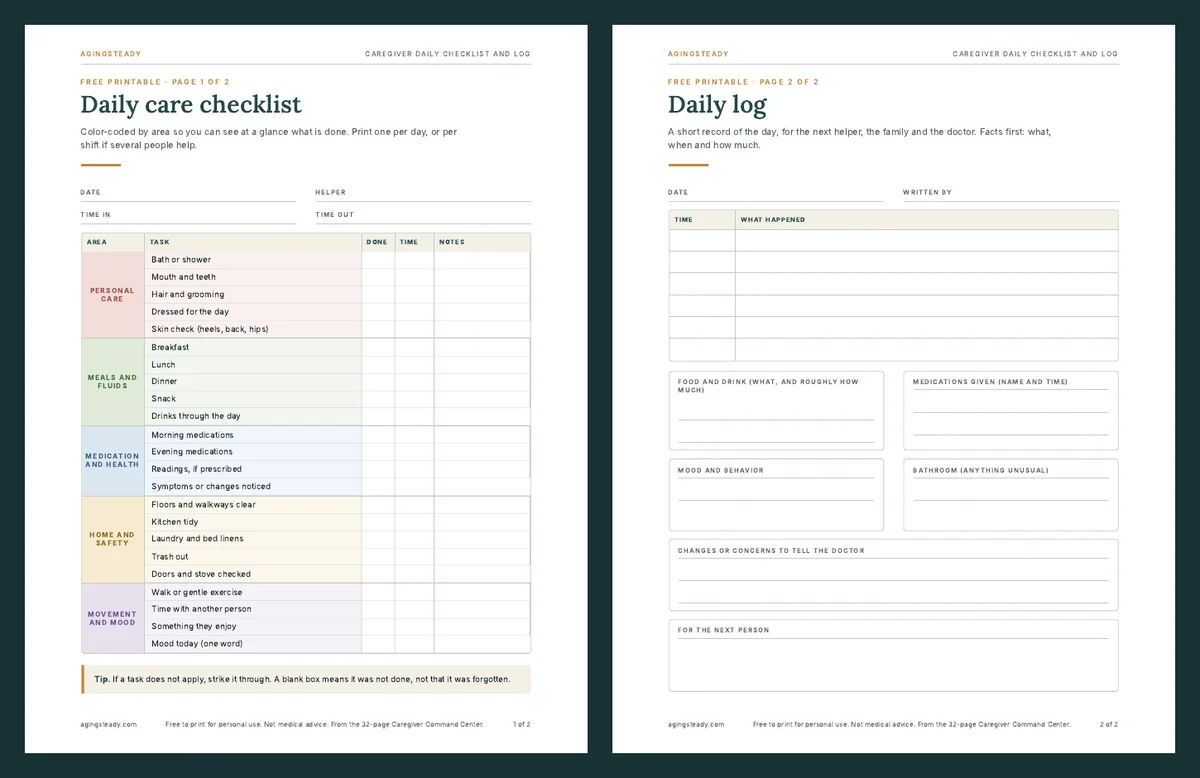
Two pages, US Letter: a color-coded daily care checklist and a daily log. No email address needed. Print one set per day, or per shift if several people help.
In this guide
What is on the two pages
| Page | Section | What it covers |
|---|---|---|
| 1. Checklist | Personal care | Bath or shower, mouth and teeth, hair and grooming, dressing, skin check. |
| 1. Checklist | Meals and fluids | Breakfast, lunch, dinner, snack, drinks through the day. |
| 1. Checklist | Medication and health | Morning and evening medications, readings if prescribed, symptoms or changes noticed. |
| 1. Checklist | Home and safety | Clear floors and walkways, kitchen, laundry and linens, trash, doors and stove. |
| 1. Checklist | Movement and mood | A walk or gentle exercise, time with another person, something they enjoy, mood in one word. |
| 2. Daily log | Through the day | A time column and a line for what happened. |
| 2. Daily log | Notes | Food and drink, medications given, mood and behavior, bathroom, concerns for the doctor, and a note for the next person. |
Each checklist row has a box for done, a box for the time and a short space for notes.
Why a daily checklist helps
Care.com, a care-services marketplace, asked clinicians what a daily senior care checklist should cover. A geriatric nurse practitioner listed medication management, meals, hygiene, exercise suited to the person, social time and hobbies, home upkeep and safety, and any health-specific tasks. Our checklist follows the same areas.
The same article gives the reasons a checklist works:
- Fewer missed tasks. An occupational therapist quoted there says a checklist is a reminder of daily tasks and lowers the chance of overlooking part of someone’s medical care.
- A steadier routine. The article says consistency can reduce anxiety and confusion, especially for people with cognitive impairment.
- Less to carry in your head. It cites a 2023 AARP survey in which half of caregivers reported more emotional stress, and says breaking the day into predictable steps can ease that.
- Better planning. Seeing what is coming helps you keep food, medications and supplies in stock.
What to write in the daily log
CareScout, a Genworth company, recommends a daily log especially when more than one caregiver is involved, because it helps both the family and the doctors. It suggests recording:
- What a typical day looked like
- Mood
- Food and fluid intake
- Bladder and bowel habits
- Medication times
DailyCaring, writing about dementia care, adds symptoms and care needs, difficult behaviors with what happened before and after, safety issues, and how a new medication or dose seems to be working. It says doctors usually want to know three things about a problem: how often it happens, how severe it is, and whether there is a pattern or trigger. Without notes, a doctor may ask you to observe and write things down for two weeks before the next visit.
So keep entries short and factual. “2:15 pm, refused lunch, ate half a sandwich at 3” is more useful than “bad afternoon”.
How to use it with several helpers
These are our own suggestions.
- Print a week of copies and keep them in one place, such as a binder or a clipboard in the kitchen.
- One sheet per day, or one per shift if helpers change during the day. Write the name and the time in and out at the top.
- Tick as you go, not at the end of the day.
- Fill in “For the next person” before you leave. One line is enough.
- Review the week on one set day. Look for patterns: skipped meals, poor sleep, a change in mood.
The National Institute on Aging’s caregiver worksheets are built on the same idea of writing tasks down so you can hand them to family or friends. When sharing duties, it advises considering each person’s limits and choosing the best person for each task. If you are hiring help, see our questions to ask when hiring a caregiver and home health aide cost guides.
Adapting it to your parent
- Strike through what does not apply. A blank box then means “not done”, not “not needed”.
- Add health tasks only as instructed. Care.com’s list includes tasks such as blood pressure or blood glucose checks. Add these when a doctor or nurse has asked for them and shown you how.
- For dementia, use the log for the things DailyCaring lists: behaviors, eating, toileting and safety. See also our guide to wandering at night.
- Keep it private. The sheets hold personal details. Do not leave them where visitors can read them.
- Keep the medication list separate. The checklist records that medications were given. The full list of names and doses belongs on its own page. See medication reminders for seniors.
More free pages
- Free printable caregiver forms: medication list, appointments, contacts and more.
- Weekly Command Sheet: the week on one page.
- Emergency Info Sheet: one page for paramedics and the fridge.
- Home Safety Checklist: a room-by-room check.
- What to put in a caregiver binder: the full list of sections, with free sources.
- Printable caregiver binders compared: free templates and paid kits side by side.
If you want all the pages ready-made, the Caregiver Command Center is our paid 32-page binder. It includes this checklist, a weekly planner, medication and appointment pages, a fillable edition and a shared family tracker.
The Aging Parent Emergency Info Sheet
Medications, contacts and legal info on one page, ready for a paramedic or hospital.
Common questions
What should a caregiver daily checklist include?
The everyday tasks that must not be missed: personal hygiene, meals and fluids, medications, movement, time with other people, and home upkeep and safety. A geriatric nurse practitioner quoted by Care.com also lists health-specific tasks, such as blood pressure readings, where a clinician has asked for them.
What is the difference between a daily checklist and a daily log?
A checklist is a list of tasks you tick off, so nothing is forgotten. A log is a short written record of what happened: what was eaten, when medications were given, mood, and anything unusual. Use the checklist to run the day and the log to tell the next person and the doctor about it.
What should I write in a caregiver daily log?
CareScout suggests a description of a typical day, a mood log, food and fluid intake, daily bladder and bowel habits, and medication times. Add the time and stick to facts. DailyCaring says doctors usually want to know how often a problem happens, how severe it is, and any patterns or triggers.
Is this caregiver daily checklist really free?
Yes. The two-page PDF downloads directly, with no email address needed, and you can print as many copies as you like for personal use. It comes from our paid 32-page Caregiver Command Center, which you do not need to buy.
How long should I keep daily logs?
There is no set rule in the sources we read. A practical approach is to keep the last few weeks in the binder and bring them to appointments, because a doctor may ask what has happened since the last visit. Keep anything about a fall, a medication change or a hospital stay for longer.
One important caveat
These pages are for organizing day-to-day care and are not medical advice. Ask the doctor, nurse or pharmacist what should be checked each day for your parent and how. If something changes suddenly, call the doctor. In a life-threatening emergency, call 911.
Sources
Care.com, Daily senior caregiver checklist (a care-services marketplace; published March 2022, updated December 2025). CareScout, Why you need a care notebook (a Genworth company; updated November 2023). DailyCaring, Keeping a dementia journal: 7 things to track (updated November 2025). NIH MedlinePlus Magazine, Caregiving 101: worksheets, resources, and suggestions from the National Institute on Aging (October 2024). We opened these pages in November 2026 and wrote our own summary. The checklist, the log and the how-to steps are ours. We welcome corrections through our contact page.