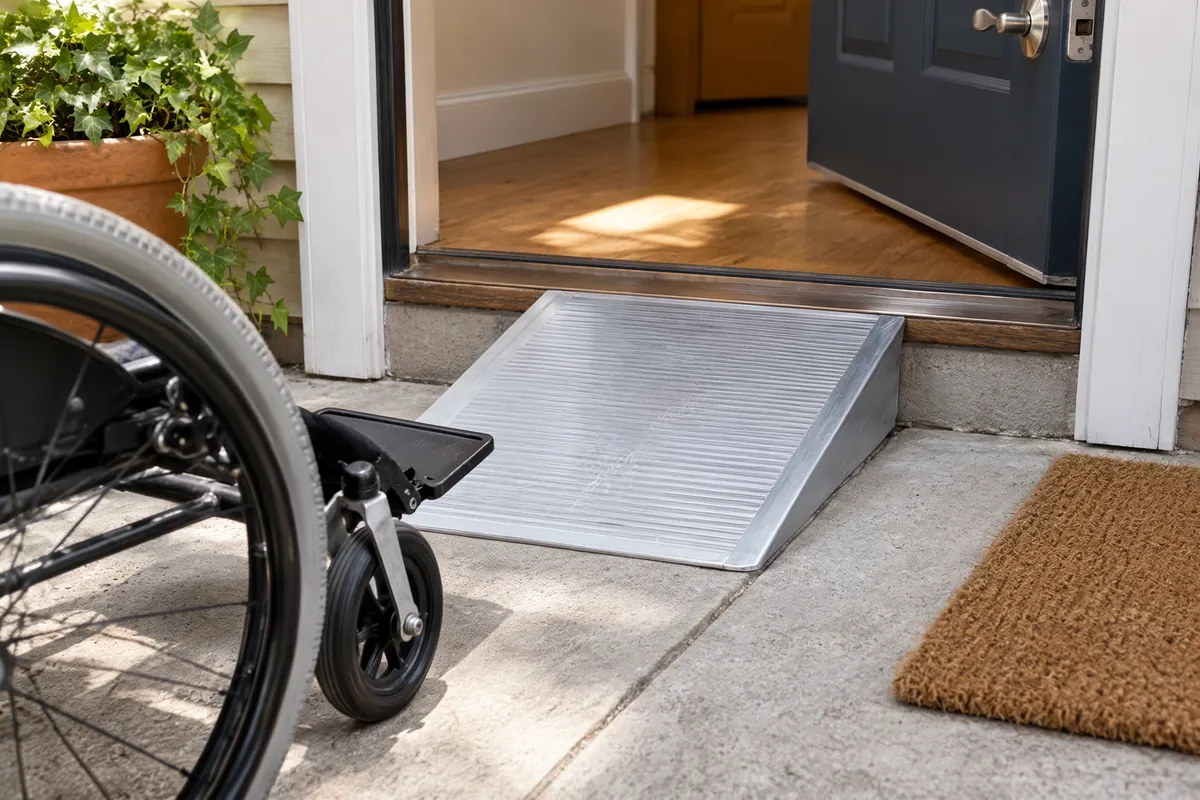
Not every home needs a long permanent ramp. Sometimes the only barrier is a raised door threshold or one low step, and a small ramp you can pick up and move is enough. The risk is buying the wrong type, or one that is too steep for the height it has to climb.
This guide explains how threshold, suitcase, folding and telescoping ramps differ, what the ADA says about door thresholds, how to think about weight capacity, and when a portable ramp is the wrong choice. It is general information and not medical advice.
The short answer
Use a threshold ramp for a raised doorway or a rise of a few inches. Use a portable folding or suitcase ramp for one or two steps and short-term needs. If your parent will need a ramp for years, or the rise is more than a couple of steps, look at a modular or permanent ramp. Measure the rise first, match the ramp length to it at 1:12, and check the weight rating against the chair, the person and anyone helping.
In this guide
What types of portable ramps are there?
| Type | What it is | Typically suits |
|---|---|---|
| Threshold ramp | A small inclined piece that smooths a raised doorway or small step; aluminum, rubber and bariatric versions exist | Rises of about 3 inches or less for aluminum plates; adjustable versions up to 9 inches (BraunAbility) |
| Suitcase ramp | Folds into a carry-style case in single, tri or multi folds | Quick setup for a step; easy to carry (Rehabmart) |
| Folding ramp | Collapses for storage and sets up between a high point and the ground | One or two steps; also common for vehicles (Rehabmart) |
| Telescoping track ramp | Extends to adjust to different heights; some are two tracks for the wheels | Variable heights; some need the device to be unoccupied during use (Rehabmart) |
These descriptions come from a mobility products manufacturer and an online retailer, both of which sell ramps, so treat them as a starting point and ask a therapist about your own situation. The retailer article we read is a 2020 update, so check current products and ratings. For longer runs and permanent options, see our wheelchair ramps for home guide.
How high can a door threshold be?
The U.S. Access Board’s guide to the ADA Standards says threshold height is limited to 1/2 inch in new construction. Anything above 1/4 inch must be beveled no steeper than 1:2, with the vertical edge rising only to 1/4 inch. For existing or altered doors it allows up to 3/4 inch if each side is beveled no steeper than 1:2. The page does not limit this rule to public buildings, but it covers doors required to comply, so it is a reference point and not necessarily a rule for a private home. Check local rules.
If your parent’s threshold is taller than that, or the door sill drops outside, that is where a threshold ramp helps. Outdoor doorways get wet, and Rehabmart notes slip-resistant tops matter most there. The Access Board also requires ramps and landings to have firm, stable, slip-resistant surfaces. Look at the 1:12 slope rule before choosing the length.
How much weight should it hold, and how wide?
- Add everything up. Rehabmart says to include the device, medical equipment, bags and any caregiver when working out the load.
- Typical ratings. Standard ramps typically support at least 300 pounds. Heavier power chairs and scooters generally need at least 600. Bariatric ramps can be rated up to 1,000 pounds, per Rehabmart.
- Width. The ADA clear width for a ramp is 36 inches minimum. A wider chair or scooter needs a wider ramp, so measure the actual chair.
- Overloading. Rehabmart says exceeding capacity can cause ramp failure.
When is a portable ramp not enough?
Rehabmart says portable ramps suit short-term needs, such as recovery where mobility is expected to improve, or use for a few months to a year. People who will need a mobility device long-term, or whose condition is progressing, may need a semi-permanent or permanent ramp, and modular ramps suit longer runs that rise more than a few stairs. Portable ramps are generally designed for one or two steps. BraunAbility similarly suggests permanent ramps for a home and portable ones for temporary visits.
If you think a permanent ramp is coming, look at who can help pay for a ramp and the tax deduction for home modifications before you spend on a short-term fix. Before any of it, a therapist can say whether your parent can use a ramp safely. Our home safety checklist covers the other trouble spots in the home.
Threshold ramps
Look for a stated weight rating that exceeds the chair plus user, a slip-resistant surface, and a height range that matches your measured rise. We have not tested these products.
How we handle this guide
AgingSteady earns a commission if you buy through the link above, which is explained in our affiliate disclosure. It does not change what we wrote. We have not tested any ramp, and our sources include a manufacturer and a retailer, noted above.
Common questions
What is a threshold ramp?
A threshold ramp is a small sloped piece that lets a wheelchair or walker cross a raised doorway, small step or curb. BraunAbility, a mobility products maker, describes aluminum threshold plates for rises of 3 inches or less and adjustable ramps for single-step rises up to 9 inches. Rubber and bariatric versions also exist.
How high can a door threshold be?
The U.S. Access Board's guide to the ADA Standards limits thresholds to 1/2 inch in new construction, with anything above 1/4 inch beveled no steeper than 1:2. In existing or altered doorways it allows up to 3/4 inch if each side is beveled. If your parent's threshold is taller, a threshold ramp or a lower threshold can close the gap.
Is a portable ramp good for a parent who will need it for years?
Often not. Retailer Rehabmart says portable ramps suit short-term needs, such as recovery, and that people who will need a mobility device long-term, or whose condition is progressing, may need a semi-permanent, modular or permanent ramp. Portable ramps are generally designed for one or two steps.
How much weight should a portable ramp hold?
Rehabmart says to add up the device, medical equipment, bags and any caregiver, and that standard ramps typically support at least 300 pounds while heavier power chairs and scooters generally need at least 600. Check the maker's rated capacity and measure your parent's actual chair.
Do portable ramps follow the 1:12 slope rule?
They should be chosen with it in mind. The ADA's maximum running slope is 1:12, one inch of rise for every 12 inches of length. A portable ramp that is too short for the rise will be steeper than that. See our guide to how long a ramp needs to be.
Should I get my parent's therapist involved?
Yes. A physical or occupational therapist who has seen your parent move can tell you whether they can use a ramp safely on their own or need help, and which type suits the doorway. Ask before you buy, since a short, steep ramp can be unsafe for someone propelling themselves.
One important caveat
This guide is general information and is not medical or construction advice. A ramp that is too steep, too weak or badly placed can cause falls. Have a therapist and a qualified installer check the plan, follow the maker’s instructions, and confirm local rules.
Sources
U.S. Access Board, Chapter 4: Entrances, Doors, and Gates (ADA Standards guide; no date shown) and Chapter 4: Ramps and Curb Ramps (no date shown). · BraunAbility (a mobility products manufacturer), How to Choose a Wheelchair Threshold Ramp (no date shown). · Rehabmart (an online retailer), How to Choose the Best Wheelchair Ramp (a 2020 update). We opened each page in November 2026. We welcome corrections through our contact page.