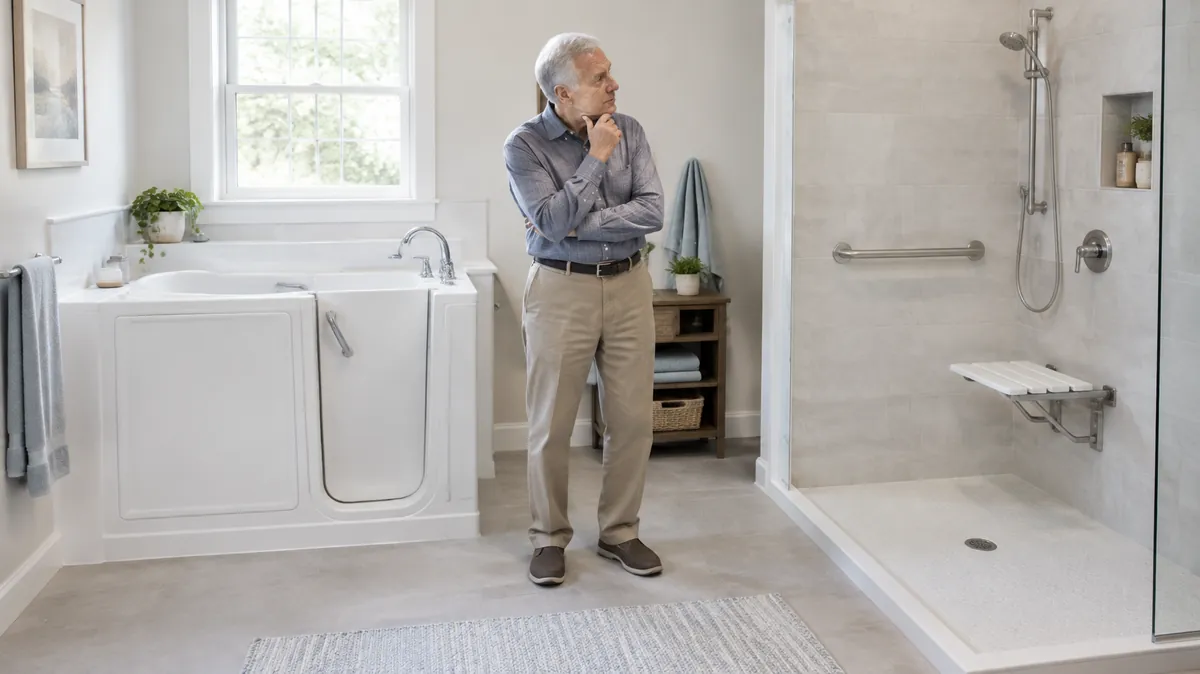
Short answer: for most seniors a walk-in shower costs less and is easier to get into, and a curbless one is the only choice that works for a walker or wheelchair. A walk-in tub fits a parent who walks steadily and wants to soak for stiff or painful joints. Both sources we read say the price varies a lot, so get written quotes for both before you decide.
The right answer depends on how your parent moves, whether a caregiver helps, and what the bathroom can hold. This guide compares the two using published cost guides and what each one is like to use. We have not tested either one, and the cost guides come from a home-services marketplace and a remodeling company, so treat the numbers as ranges.
In this guide
What each one costs
| Option | Block Renovation | Angi |
|---|---|---|
| Walk-in tub | $5,000 to $20,000, with many projects at $8,000 to $15,000 | No installed price given |
| Walk-in shower, overall | $3,000 to $12,000 | $1,200 to $20,000, average about $9,000 |
| Prefab tub-to-shower conversion | $3,000 to $6,000 | Tub-to-shower conversion $1,200 to $15,000 |
| Tiled walk-in shower | $6,000 to $12,000 | Not broken out |
| Tiled curbless shower | $8,000 to $17,000. Curbless adds $2,000 to $5,000 | Not broken out |
These two guides do not agree with each other, and our own walk-in tub cost guide found $3,500 to $10,000 for a typical tub from other sources. Block Renovation also says moving the drain or valve adds $1,500 to $3,000 and permits run $200 to $1,000, and that a walk-in tub often needs a bigger water heater because it holds about 40 to 80 gallons. Jets and air systems add several thousand dollars. Ask each company which of these extras its quote includes.
Side by side: safety, access and comfort
| Question | Walk-in tub | Walk-in shower |
|---|---|---|
| Getting in | A threshold of about 3 to 7 inches, against about 14 inches for a regular tub wall, plus a built-in seat | A curb of about 3 to 4 inches, or none at all if it is curbless |
| Walker or wheelchair | The door is usually too narrow for either | A curbless shower can take a walker, wheelchair or rolling chair. A standard curb still blocks a walker |
| Waiting at the end | You sit in the tub until the water drains before the door opens | No wait |
| Room for a caregiver | Limited | More room, especially curbless |
| Soaking for pain or stiffness | Yes. Deep soaking is the main reason to choose a tub | No |
| Slip risk | Water stays inside the tub | Water spreads over the floor, so slip-resistant flooring, good drainage and grab bars matter |
| Water and heat | Holds more water and may need a bigger water heater | Uses less water, but heat escapes more easily |
| Work involved | Needs its own drain and often electrical work | A prefab conversion can take a few days. Curbless means rebuilding the floor and takes longer |
Angi lists grab bars, a built-in seat and a handheld showerhead as the usual accessibility add-ons for a shower. Our grab bar guide and bathroom safety checklist cover what to add whichever you choose.
Who each one suits
- Uses a walker, rollator or wheelchair: a curbless shower. A walk-in tub door is usually too narrow.
- Walks steadily but struggles with the tub wall: either one. A shower with a bench costs less. A walk-in tub suits someone who wants a soak.
- Cannot stand for long: either one with a seat. The shower bench is the cheaper fix.
- Needs soaking for arthritis or chronic pain: a walk-in tub, if your parent can sit and wait for it to fill and drain safely.
- Needs a caregiver’s help: a curbless shower, for the extra room.
- Has a small budget: start with a prefab shower conversion, or with a shower bench, grab bars and a handheld showerhead on the existing shower. Get a quote before you assume a full remodel is needed.
Low-cost helpers for the bathroom you already have
A full remodel is not always the first step. If your parent can still step over the tub wall or the curb, a few inexpensive items can make the current bathroom safer while you get quotes. We earn a commission if you buy through the links below, at no cost to you, and we have not tested these products. Check the weight rating and size against your parent and your bathroom before you buy.
Shower chair or bench
A seat lets your parent sit while washing. A transfer bench spans the tub wall, so they sit down outside the tub and slide over instead of stepping in. Check the weight capacity, that the legs can be adjusted to the right height and that the feet grip the floor. A bench that is too narrow or too tall can make things worse.
Handheld showerhead
Angi lists a handheld showerhead as a common accessibility add-on. It lets your parent, or a caregiver, direct the water while seated. Look for a long hose and a holder mounted at a height your parent can reach without stretching.
For grab bars, see our grab bar guide. It explains which ones are safe to lean on and which are only for light balance, and why a bar must go into a wall stud.
Before you decide
An occupational therapist can watch how your parent moves in the bathroom and tell you which setup fits. Ask their doctor for a referral. Pair that with at least two written quotes that list the same items, and see what Medicare does and does not cover before you count on help paying.
What to ask before you sign
- Can I see the quote broken down: fixture, labor, plumbing, electrical, permits and removal of the old tub?
- Is the water heater big enough, and is a new one in the price?
- For a shower: is the floor slip-resistant, where does the water drain, and is the curb height right for a walker?
- For a tub: how wide is the door, how long does it take to fill and drain, and can my parent get out safely while it drains?
- What does the warranty cover, and who services it?
- If the house is sold later, will the home still have a regular tub somewhere?
Get the Free Home Safety Checklist
A printable room-by-room checklist for bathrooms, bedrooms, kitchens, stairs and hallways.
Common questions
Is a walk-in shower or a walk-in tub safer for a senior?
Neither is automatically safer. Block Renovation says a curbless shower is the better choice for a walker, rollator or wheelchair, because a walk-in tub door is too narrow for them and a standard shower curb still blocks a walker. Angi says a walk-in shower removes the high tub wall that people have to step over, but water spreads across the floor, so slip-resistant flooring matters. For someone who walks steadily and wants to soak for joint pain, a walk-in tub can fit.
Which costs less, a walk-in tub or a walk-in shower?
Usually the shower, but the ranges are wide and overlap. Block Renovation puts a walk-in shower at $3,000 to $12,000 and a walk-in tub at $5,000 to $20,000. Angi gives walk-in showers $1,200 to $20,000 with an average near $9,000. Our walk-in tub cost guide found $3,500 to $10,000 for a typical tub from other sources. The type of shower and the plumbing changes decide the price, so get quotes for both.
Can you take a shower in a walk-in tub?
It depends on the model. Some come with a hand shower, but you are still sitting in a closed tub, and with a tub you wait for the water to drain before the door opens. Block Renovation lists that wait as a drawback. Ask the seller exactly how showering works on the model you are pricing.
Does a walk-in tub or shower hurt the value of the home?
It can if it replaces the only tub in the house. Block Renovation says the effect is small when another full bathroom still has a conventional tub, and that some buyers with young children want a tub. Angi says tubs can add value because of how buyers see them. If your parent owns the home, think about whether another bathroom keeps a regular tub.
Does Medicare pay for a walk-in tub or walk-in shower?
Generally not. Original Medicare usually does not classify either as covered equipment. Some Medicare Advantage plans, Medicaid programs and VA programs may help in limited cases. Our guide to Medicare coverage for walk-in tubs and showers goes through what to ask.
Which is better for someone who needs help bathing?
Block Renovation recommends a curbless shower when a caregiver helps, because it gives more room to work and nobody waits for a tub to drain. A walk-in tub leaves little space for a caregiver beside the person. If bathing is a struggle for other reasons, see our guide to when a parent refuses to bathe.
One important caveat
This guide is general information for caregivers and is not medical, legal or financial advice. Prices, products and building rules vary by home and region. Confirm details with a licensed contractor and, for safety questions, with your parent’s doctor or an occupational therapist.
Sources
Angi, Walk-in shower vs. tub (cost ranges, pros and cons, water and home value). Block Renovation, Walk-in tub vs. walk-in shower for seniors (cost ranges, door and threshold sizes, who each suits). We opened both in November 2026. Angi is a home-services marketplace and Block Renovation is a remodeling company, and both have an interest in remodeling work, so we show their ranges next to our own cost guide rather than picking one. The comparison and checklist are our own summary. We welcome corrections through our contact page.