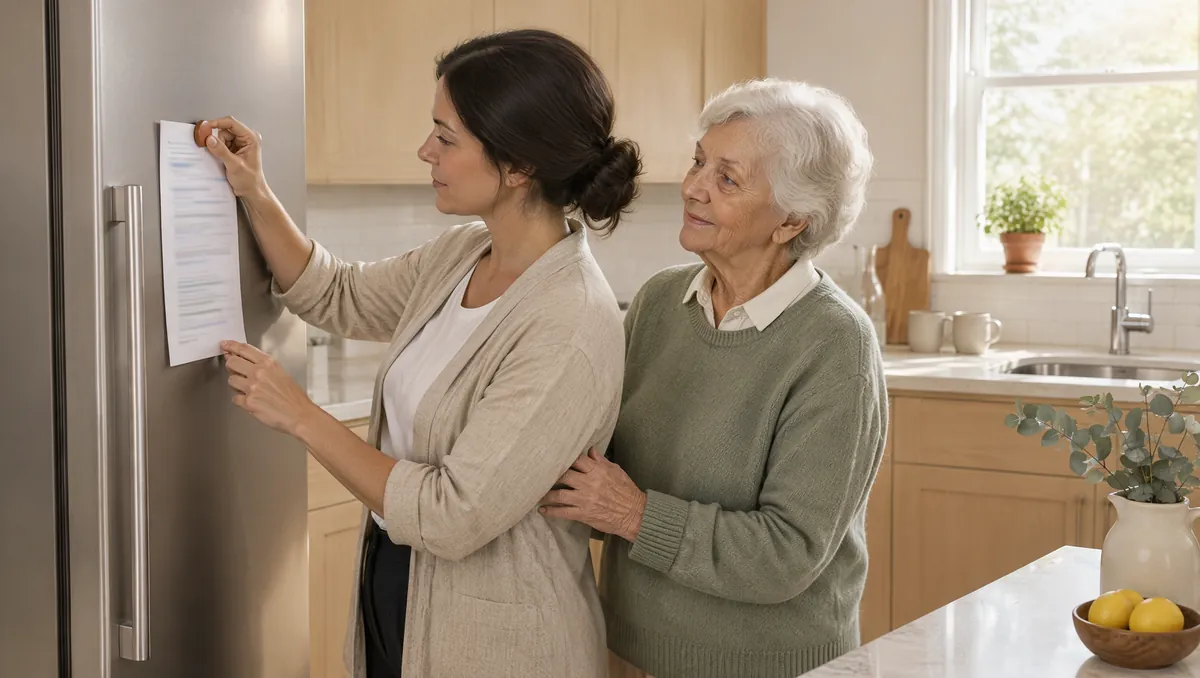
In an emergency, an older parent may be frightened, confused or unable to speak. The first people on the scene need facts fast: what medications are taken, what allergies exist, who to call. A one-page emergency information sheet puts those answers where anyone can find them.
This guide lists what to put on it, where to keep it and how to keep it current. It summarizes pages from Care.com, Saint Vincent Hospital and the AGS Health in Aging Foundation, named where they are used. We are an independent research site, not a medical provider. At the end we offer our own free sheet. It is a short fill-in form made by us, and it comes from the same family as our paid Caregiver Command Center, which you do not need to buy.
In this guide
What to include
Care.com published a checklist, updated in January 2026 and quoting nurses, a physician, an eldercare attorney and a geriatric dietitian. Our table groups its list with what the other sources add.
| Section | What to write | Why a responder wants it |
|---|---|---|
| Personal details | Full name, date of birth, address, main language. Care.com suggests the house number be visible from the street. | To identify the person and find the home. |
| Emergency contacts | At least three people, in the order to call, with phone numbers. Note who holds power of attorney. | Someone to inform, and someone who can decide. |
| Doctors and hospital | Primary doctor, specialists, preferred hospital, pharmacy. | To get records and send the person to the right place. |
| Medications | Each medication, the dose and what it is for. | To avoid harmful interactions and start treatment sooner. |
| Allergies and conditions | Drug allergies and chronic conditions such as heart disease, diabetes or seizures. | Allergies and history change what a clinician can safely do. |
| Insurance | Medical and prescription plan names and ID numbers, and Medicare number if relevant. | Hospitals ask at admission. |
| Legal wishes | Whether an advance directive exists and where it is, the health care proxy, and resuscitation (DNR) status. | So wishes are known if the person cannot speak. |
| Notes | Memory or cognitive changes, mobility needs, dietary needs and communication needs. | Helps staff communicate and care safely. |
Saint Vincent Hospital’s File of Life, a red magnetic packet, holds much the same: existing conditions, medications with doses and schedules, allergies, doctors, dietary and communication needs and emergency contacts. Its emergency chief says knowing the history lets first responders begin treatment at once.
Where to keep it
- In plain sight at home. Care.com suggests an easy-to-find, commonly used place such as near the kitchen phone, with the pages clipped together on the fridge. Saint Vincent Hospital also says the refrigerator.
- Agree not to move it. Care.com says the senior, family and caregivers should all agree on the spot.
- A copy with someone else. Give one to a family member, caregiver or friend.
- A copy in the wallet. The AGS Health in Aging Foundation says very elderly or disabled adults can carry their medical details in a wallet. It also suggests considering an engraved medical ID bracelet or pendant.
- A full copy in the binder. See what to put in a caregiver binder.
Keeping it up to date
An outdated sheet can mislead. Care.com notes that medications change often. Saint Vincent Hospital says to review its File of Life about every six months. Our suggestion is to check it after each appointment and each hospital stay. Write the date on it, and cross out and replace the old copy rather than adding a second one.
If the medication list is the part that goes stale, see medication reminders for seniors. After a hospital stay, see our hospital discharge checklist.
What to leave off
Care.com’s list also mentions the Social Security number and financial records. We would keep those off a sheet that hangs in a kitchen, since visitors can read it. This is our own view, not the source’s. Write where those documents are kept instead, and put the details in a locked place that a trusted person knows about.
Our free sheet
Our sheet is two pages to fill in by hand: basic information, three emergency contacts in order, the medical team, a medication table, allergies and conditions, cognitive and mobility notes, and the legal section with advance directive, health care power of attorney and DNR status. It comes with a short cover page. It is free, and you can print as many copies as you need for personal use. Use the form on this page to get it.
For the rest of the binder, see the Caregiver Command Center, our paid 32-page binder, or compare options in printable caregiver binders compared. If you want a daily record as well, the daily checklist and log is free.
The Aging Parent Emergency Info Sheet
Medications, contacts and legal info on one page, ready for a paramedic or hospital.
Common questions
What should be on an emergency information sheet for an elderly parent?
Personal details, emergency contacts in the order to call, doctors and the preferred hospital, current medications with doses and what each is for, allergies, medical conditions, insurance details, and any advance directive, health care proxy or resuscitation wishes. Care.com's checklist, written with clinicians, covers these areas. Our free sheet has fields for all of them.
Where should the sheet be kept?
Where a responder will find it fast. Care.com suggests an easy-to-find, commonly used spot such as near the kitchen phone, with the pages clipped together on the fridge, and says everyone involved should agree not to move it. Saint Vincent Hospital's File of Life, a similar one-packet system, is also kept on the fridge. Give a copy to a family member or friend as well.
How often should it be updated?
Whenever something changes: a new medication, a new doctor, a hospital stay. Saint Vincent Hospital says its File of Life should be reviewed about every six months. Care.com does not give a schedule and notes that medications change often. A simple habit is to check it after every appointment.
Is it safe to put medical details on the fridge?
It is a trade-off. A sheet in plain sight helps responders, and it can also be read by visitors. A common approach, and our own suggestion, is a short fridge copy with the essentials and a fuller copy kept in the binder. Leave off Social Security and bank account numbers, and write where those documents are kept instead.
Is this a medical ID?
No. It is a paper summary. The AGS Health in Aging Foundation also suggests considering a medical ID bracelet or pendant engraved with conditions, allergies, medications and contacts, and says very elderly or disabled adults can carry the information in a wallet instead.
One important caveat
This sheet organizes information and is not medical advice. Ask the doctor or pharmacist to check the medication list, and an elder law attorney about documents such as a health care proxy. In a life-threatening emergency, call 911.
Sources
Care.com, Emergency medical checklist for older adults (a care-services marketplace; published March 2022, updated January 2026). Saint Vincent Hospital, File of Life document considered a lifesaver, especially for older adults (December 2023). AGS Health in Aging Foundation, Tip sheet: emergency preparedness for older adults (last updated September 2019). We opened these pages in November 2026 and wrote our own summary. The table, the privacy note and the form are ours. We welcome corrections through our contact page.