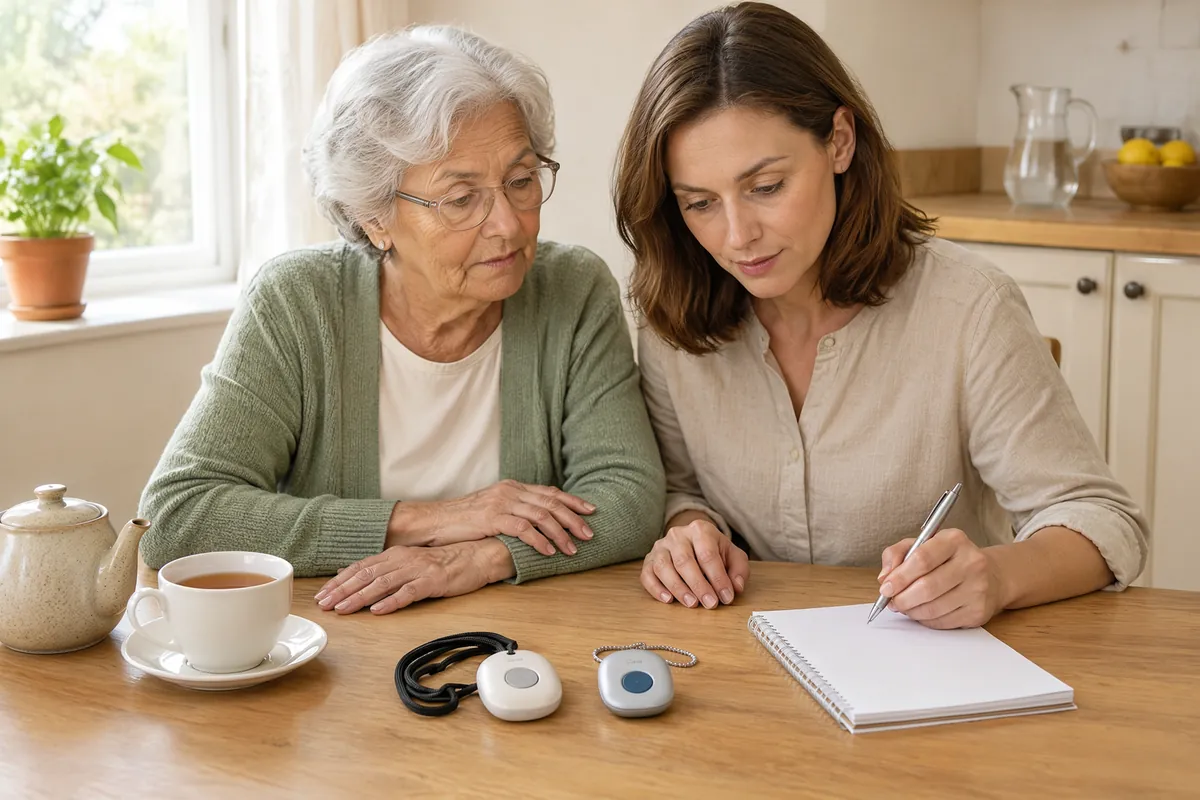
Alert1 and MobileHelp both sell medical alert systems for a parent who lives alone, and both come up often when families compare. This page sets them side by side using independent reviews and flags where those reviews disagree with each other, which they do on prices and contract terms.
We have not tested either company’s devices. Everything below comes from the sources at the end, and prices and terms change, so confirm them with the company before you buy.
The short answer
The sources do not point to a clear winner. Alert1 has no equipment fee, a landline, cellular and GPS wearable line-up, and language support in over 190 languages, but NCOA’s testers heard garbled audio and NCOA lists customer service as weekday business hours only. MobileHelp has a GPS model and caregiver alerts as an add-on, but one reviewer found its fall detection less accurate than a rival’s, and customers complain about returns and fees. For prices and contract terms, the reviews contradict each other, so get both in writing.
In this guide
How do Alert1 and MobileHelp compare side by side?
| Feature | Alert1 | MobileHelp |
|---|---|---|
| In-home unit price | $30 (NCOA) or $28.95 monthly and $19.95 annual (SeniorLiving.org) | $29.95 for Classic Landline and Classic Cellular (NCOA) |
| GPS model | LifeBeacon wearable, $45 (NCOA); On-the-Go with GPS, $38.95 monthly or $29.95 annual (SeniorLiving.org) | Elite, $41.95 (NCOA), AT&T LTE with GPS |
| Fall detection | Add-on: $5 a month (NCOA) or $10 a month (SeniorLiving.org) | $10 a month add-on on Classic Cellular and Elite, not on Classic Landline (NCOA) |
| Contract | No long-term contract per NCOA and SeniorLiving.org; Caring.com says no month-to-month | Three-month minimum per NCOA; The Senior List says no long-term contract |
| Equipment and activation fees | No equipment fee; NCOA lists no activation fee, SeniorLiving.org lists $19.95 (and says it is waived on annual plans) | None on the main units per NCOA and The Senior List; Caring.com lists $49.95 activation and $15 shipping on the Classic monthly plan |
| Battery | LifeBeacon about 10 days (NCOA); In-home pendant about 3 years (NCOA) | Classic base 30-hour backup; Elite up to 6 days (NCOA) |
| Caregiver alerts | NCOA lists no caregiver alerts on its three main models | OnGuard caregiver alerts, $2.99 a month add-on (NCOA) |
Figures are as each review reported them in 2026 and do not agree in every row. Confirm current prices with each company.
What do they cost, and what are the contract terms?
This is where the reviews diverge most. For Alert1, NCOA (September 2026) lists $30, $40 and $45 a month for its three main models, and SeniorLiving.org (February 2026) lists $28.95 on a monthly plan and $19.95 on an annual plan for the in-home unit, with its GPS wearable at $38.95 monthly or $29.95 annual. NCOA notes that annual billing is charged upfront. The Caring.com comparison gives a range of $19.95 to $58.95 a month across its plans.
For MobileHelp, NCOA and The Senior List both list the Classic plans at $29.95 a month and the Elite at $41.95. Our MobileHelp review covers its fees and return rules in more detail, including a three-month minimum that NCOA reports and The Senior List describes differently.
Practical takeaway: compare the same kind of unit, with fall detection on or off, billed monthly or annually, and ask each company for the first-month total including any activation, shipping or protection plan charges.
How do the fall detection options compare?
Both companies sell fall detection as an extra, not as part of the base price. NCOA lists it at $5 a month on Alert1, while SeniorLiving.org says $10, and NCOA lists $10 for MobileHelp. SeniorLiving.org’s reviewer says Alert1’s pendant “doesn’t detect 100 percent of falls” and suggests pressing the help button when possible. The Senior List found MobileHelp’s fall detection caught a majority of falls but was less accurate than Medical Guardian’s, and some ConsumerAffairs reviewers describe false alarms.
We found no test that put the two side by side. If falls are the main worry, read fall detection for seniors living alone and smartwatch fall detection before deciding.
What do the response tests show?
- Alert1, NCOA: average response of 36 seconds in testing. NCOA’s testers described garbled or cutting-out audio, one of three test calls as curt, and gave the help button test 2 out of 5. NCOA lists customer service as Monday to Friday during business hours.
- Alert1, SeniorLiving.org: response of 20 to 45 seconds, and support in over 190 languages. The reviewer tested a system for over 50 hours and called setup straightforward.
- MobileHelp, NCOA: about seven seconds to reach a human on the standard device and about 15 on the Elite, with an AI assistant answering first.
- MobileHelp, The Senior List: an average of 26 seconds over 10 test calls.
These tests used different methods, on one device each, at one time, so they are not a ranking. Response times also depend on the cell signal in your parent’s home.
On customer complaints, we could open ConsumerAffairs data only for MobileHelp, which showed 3.6 out of 5 from 373 reviews with complaints about returns, a restocking fee and automatic renewals. We did not find Alert1 customer-review data that we could open, so we cannot compare the two on that point.
Which one might suit which parent?
These are our readings of what the sources say, not recommendations.
- A parent whose first language is not English. Alert1 advertises support in over 190 languages per SeniorLiving.org and Caring.com.
- A parent with no landline. Both sell cellular models, so this does not separate them.
- A caregiver who wants activity alerts. NCOA lists caregiver alerts for MobileHelp as an add-on, and none on Alert1’s three main models.
- A parent who wanders outside the home. Compare GPS models on battery and price, and see our GPS tracker guide.
- A tight budget. See our guide to systems with no monthly fee, and our full comparison for other brands.
What should you ask before you buy?
These are our own suggestions, not a list from the sources.
- What is the total for the first month and the first year, with fall detection, and any activation, shipping or protection plan fees?
- Is there a minimum term, and what happens to the equipment and any prepaid months if you cancel?
- Does the plan renew automatically, and how is notice given?
- Is there a trial period, and what must be true to get a refund (a test call, original condition, return shipping)?
- Does the signal work in your parent’s home? Run the test call with them in the bathroom and the kitchen.
- Who gets called first, and can you add family and a spare key holder?
How we handle this guide
AgingSteady earns a commission on some links, as explained in our affiliate disclosure. This page links to no seller and recommends no product. NCOA and SeniorLiving.org say they earn commissions from provider links, and The Senior List sells links to the products it reviews, so weigh their rankings with that in mind. We have not tested either device.
The Aging Parent Emergency Info Sheet
Medications, contacts and legal info on one page, ready for a paramedic or hospital.
Common questions
Is Alert1 or MobileHelp cheaper?
It depends on which review you read, because the sources disagree. NCOA (September 2026) lists Alert1 at $30 a month for the landline in-home unit, $40 for the cellular unit and $45 for the wearable, with fall detection $5 a month extra. SeniorLiving.org (February 2026) lists Alert1 in-home at $28.95 on a monthly plan or $19.95 on an annual plan, with fall detection $10 extra. NCOA lists MobileHelp at $29.95 a month for the Classic plans and $41.95 for the GPS Elite, with fall detection $10 extra. Check the live price for the exact model on each company's site.
Does Alert1 require a contract?
NCOA and SeniorLiving.org both say Alert1 has no long-term contract and lets you pay monthly or annually. A Caring.com comparison instead says Alert1 offers quarterly, semi-annual and annual plans with no month-to-month option. Ask for the terms in writing before you buy.
Does MobileHelp require a contract?
NCOA says new customers have a three-month minimum, then month-to-month, quarterly or annual billing. The Senior List describes it as no long-term contract with cancellation possible after three months. Ask MobileHelp for the exact terms in writing, including the equipment return rules.
Which has better fall detection?
We found no head-to-head test of the two. NCOA lists fall detection as an add-on for both brands. The Senior List found MobileHelp's detected a majority of falls but less accurately than Medical Guardian's, and SeniorLiving.org says Alert1's pendant does not detect every fall and recommends pressing the button when you can. No fall detection is complete, so a parent who may not be able to press a button needs a closer look at the options.
Which has the faster emergency response?
Test results vary and are not a guarantee. NCOA's testers averaged 36 seconds on Alert1, with garbled audio in some calls, and reached a human at MobileHelp in about seven seconds on the standard device and about 15 on the Elite. SeniorLiving.org gives Alert1's response as 20 to 45 seconds, and The Senior List averaged 26 seconds over ten MobileHelp test calls. The tests used different methods, so do not treat the numbers as a ranking.
Do Alert1 and MobileHelp work without a landline?
Yes, both sell cellular options. NCOA lists Alert1's EZ Care Plus In-Home unit and LifeBeacon wearable as cellular, on AT&T for the EZ Care Plus unit (NCOA does not name the LifeBeacon's carrier), and MobileHelp's Classic Cellular and Elite as AT&T LTE. Both also sell landline units.
One important caveat
This guide is general information and is not medical or financial advice. No alert system prevents falls or guarantees a response. Check current prices, contract terms and coverage with the company, and ask your parent’s doctor about what level of monitoring they need.
Sources
NCOA, Alert1 review (September 22, 2026; supported in part by affiliate commissions). · SeniorLiving.org, Alert1 review and pricing (February 18, 2026; supported by provider commissions). · Caring.com, Alert1 vs MobileHelp (no date shown; no affiliate disclosure on the page we read). · NCOA, MobileHelp review (September 28, 2026). · The Senior List, MobileHelp hands-on test (August 12, 2026). · ConsumerAffairs, MobileHelp reviews (page updated November 14, 2026; customer opinions). We opened these pages in November 2026 and wrote our own summary. We welcome corrections through our contact page.