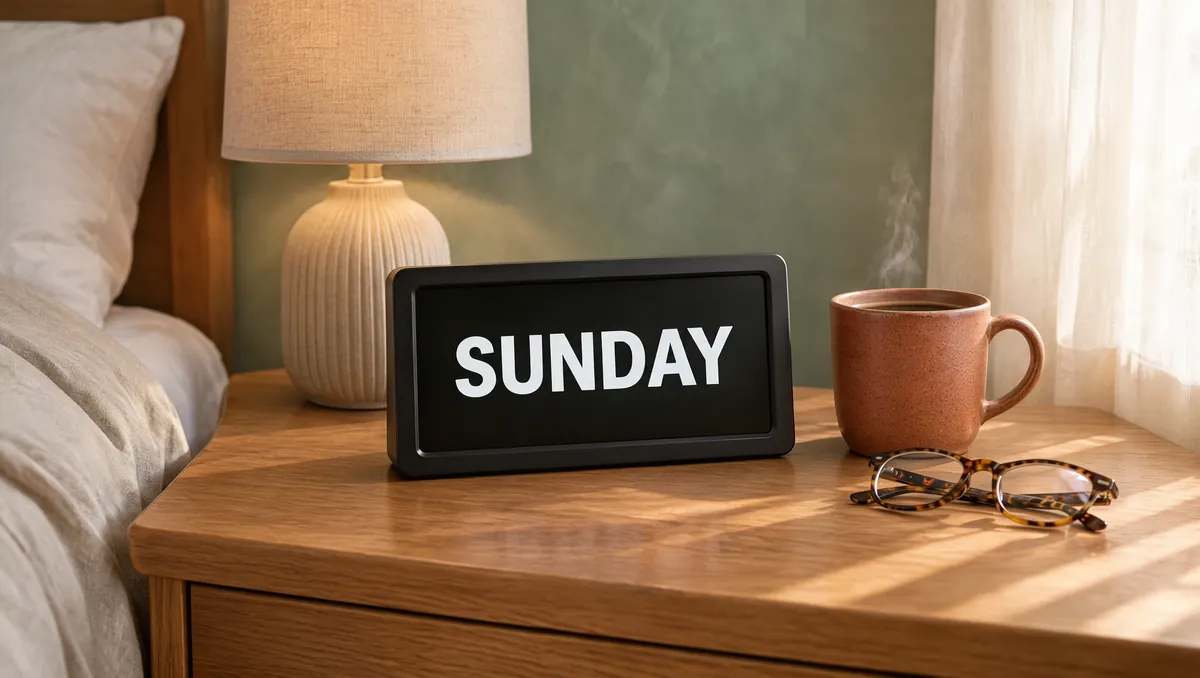
A person with dementia may wake in the afternoon and think it is morning, or ask what day it is several times an hour. A clock that shows the day and date in plain words can answer the question without you, and may make mornings less unsettling.
This guide explains what the care providers we read say to look for, and compares the main types. We have not tested any clock, and we do not name a best product, because the right one depends on your parent’s stage, eyesight and room. The evidence for these clocks is limited, so think of one as a small aid.
In this guide
Features that matter
Two UK care providers, Prestige Nursing & Care and Helping Hands Home Care, describe these features. Both are providers’ blog posts, not studies, so we use them as a checklist and not as proof.
- A clear time and date display. Large numbers or pictures, with the day of the week spelled out.
- Large, easy-to-see fonts or LED digits.
- Large, clearly labelled buttons. Prestige says small buttons on a standard alarm clock can be a barrier.
- A morning, noon and night indicator. Some clocks use simple pictures, such as stars on a dark background.
- Adjustable brightness and a simple layout.
- Spoken time and date. Talking clocks and watches announce the time, and some announce automatically at set hours.
- Reminders. Programmable alarms for medication, appointments or social plans. Check that you can set these yourself.
- Self-setting. Radio-controlled models adjust for daylight saving time.
- A photo frame. Some models let the person see familiar faces when they check the time.
Types of clock compared
These are general descriptions, not claims about any product.
| Type | What it shows | Watch out for | May suit |
|---|---|---|---|
| Digital day and date clock | Time, day of the week and date in words on one screen | Crowded screens and tiny text. Check that it spells the day in full. | Most people with memory loss who can still read |
| Day clock with time-of-day cue | Words such as morning, afternoon, evening, night, sometimes with pictures | Labels that do not match your parent’s own routine | Someone who mixes up day and night |
| Large analogue wall clock | Familiar hands on a large face | Prestige says it may not suit the middle to late stages | Early stages, where it feels familiar |
| Talking clock or watch | Announces the time, date or time of day aloud | A voice may startle some people. Check volume control. | Someone with poor sight |
| Clock with reminders or photo frame | Time plus programmable alerts or family photos | More features mean more settings. Keep it simple. | Someone who responds to prompts and familiar faces |
How to choose for your parent
- Ask the doctor or care team. Prestige suggests talking to the GP or medical team before choosing a model.
- Check eyesight first. A large display is no help if glasses are missing or the room is dark.
- Place it where your parent sits or lies. A bedside clock for the night, another in the main chair, and keep the old wall clock if it still helps.
- Keep one clock per room, not five. Several clocks that disagree add confusion.
- Dim it at night. Look for adjustable brightness so the room is not lit by the screen.
- Check the return policy. If your parent ignores it or dislikes it, you want to send it back.
- Watch for a week. Notice whether your parent looks at it, and whether it helps or upsets them.
A clock is one part of a calm routine. If confusion about day and night is becoming a worry, our guide to wandering at night covers routines and when to talk to the doctor, and the daily checklist and log helps you spot patterns.
Where to compare options
We link to a search for each type so you can see current options, prices and reviews. These are not recommendations of any specific product.
Digital day and date clock
Clock with time-of-day cue
Talking clock
How we handle product links
AgingSteady earns a commission on some links, which is explained in our affiliate disclosure. We have not tested these clocks, we show no ratings, and the order above has nothing to do with what we earn.
Common questions
Why do people with dementia need a day and date clock?
Losing track of the day or date is common with dementia, and a clear display can help a person orient themselves. Helping Hands Home Care says that waking up disoriented, or not knowing the time of day, can be unsettling, and that a clock can help someone reorient. We found no study showing how well any clock works, so treat it as a low-cost aid and not a treatment.
Is a digital or an analogue clock better?
It depends on the stage. Prestige Nursing & Care says analogue wall clocks with larger hands and fonts can feel familiar, but may not be appropriate in the middle to late stages of dementia, since reading an analogue face can become hard. A digital clock that spells out the day and date removes that step. If your parent still reads a wall clock easily, there is no need to take it down.
What features matter most?
From the two providers we read: large, clear numbers or words for the time and day, easy-to-see fonts, large clearly labelled buttons, a display you can dim at night, and a simple layout. Some also offer a morning, noon and night indicator, a spoken announcement, programmable reminders, or a built-in photo frame.
Can a clock cause confusion?
It can if the display is crowded, or if the day and the date are not shown clearly. Standard alarm clocks often have small buttons and hard-to-read numbers, according to Prestige Nursing & Care. A very bright screen at night may also disturb sleep, so choose one with adjustable brightness. Put it where your parent sees it from their chair or bed, and watch how they respond in the first week.
Do dementia clocks need setting?
Some do. Helping Hands Home Care describes radio-controlled models that set themselves and adjust for daylight saving time, which saves you a task. Check that a model you buy does this, and what happens after a power cut or when the battery runs out.
One important caveat
This guide is general information for caregivers and is not medical advice. A clock cannot treat or slow dementia. If your parent is newly confused about time or day, tell their doctor, because sudden changes can have causes that need treatment.
Sources
Prestige Nursing & Care, The Best Clocks for People with Dementia (read in November 2026; published May 2023, last modified October 2025; a provider’s blog with no studies cited). · Helping Hands Home Care, Helpful Clocks for People with Dementia (read in November 2026; last modified December 2025; also a provider’s blog, and it does not compare analogue with digital). Both are UK providers, so some product names will not match what is sold in the US. The type descriptions in our table are general and not checked against any maker’s specifications. We welcome corrections through our contact page.