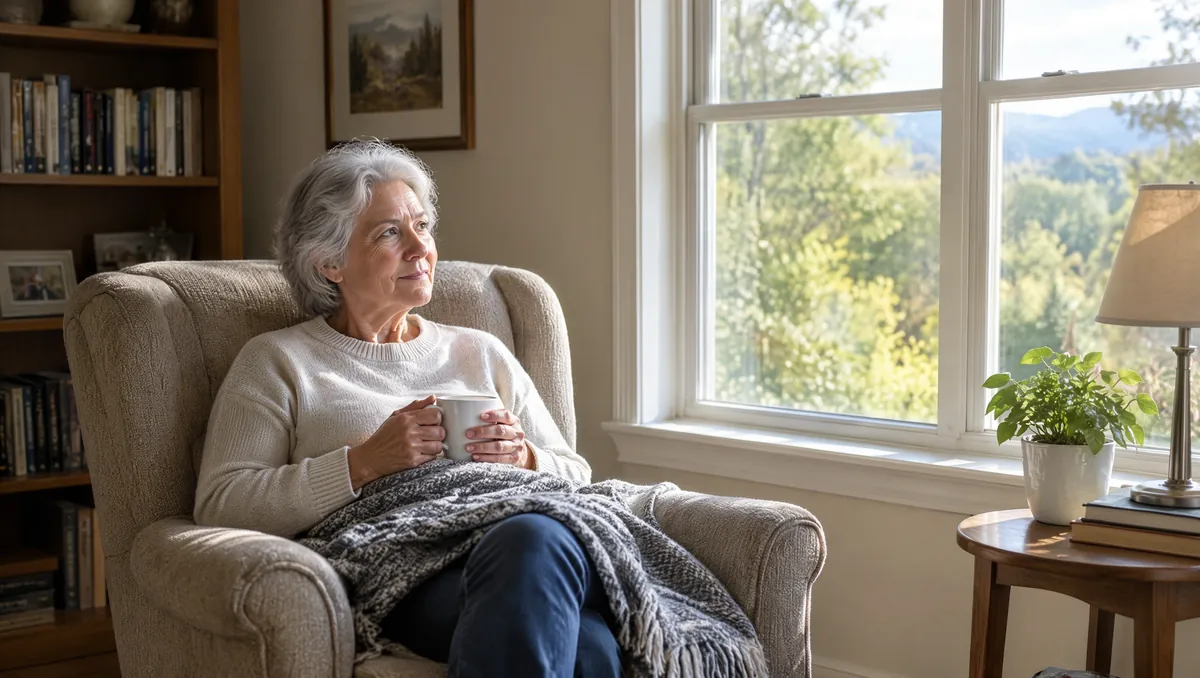
Most families reach this question slowly. Your parent has been fine alone for a few hours, then something small happens: a pan left on, a missed pill, a walk that took too long. You start to wonder whether it is still safe to leave the house.
There is no single age, stage or number of hours that answers it. This page sets out the warning signs that hospitals and Alzheimer’s organisations describe, a way to review the risks one by one, and the options when the answer is “not for long.” It is not medical advice, and your parent’s doctor should be part of the decision.
In this guide
The short answer
It depends on the person. Michigan Medicine’s Geriatrics Center says there is no easy answer: it depends on how the disease is progressing, how the person is responding, the home itself and how much risk the family can accept. UMass Memorial Health says that many people with dementia can manage daily tasks with little help early on, but that there comes a point when living alone is no longer safe, and that the timing varies.
So the useful question is not “how long?” but “what could go wrong while I am out, and would my parent be able to deal with it?”
Warning signs it may not be safe
Alzheimer’s San Diego lists these as signs that a person probably should not be left alone:
- Wandering. Leaving home without identification, a phone or proper clothing, and not asking for help if lost.
- Medication confusion. Losing track of what has been taken and when.
- Missed meals and fluids. Forgetting to eat or drink.
- Kitchen hazards. Forgetting to turn off appliances.
- Falls. Changes in coordination, vision or depth perception, especially around steps, rugs and clutter.
- Anxiety or agitation. Pacing, following you closely or asking many questions may be a sign of distress when alone.
- No emergency response. If they cannot recognise an emergency or explain how to respond, such as calling 911, they should not be left alone.
UMass Memorial Health adds forgetting to bathe and financial problems, and says to talk to the person’s doctor if you see these.
A risk review you can do this week
Michigan Medicine’s patient education sheet suggests going through the questions below. We have turned them into a short list. Answer them for your own parent, ideally with a sibling or another carer, since families often disagree about how much risk is acceptable.
- Do they smoke, or leave cigarettes burning?
- Do they leave the stove on or burn pots and pans?
- Would they know what to do in an emergency? Ask them to show you, not tell you.
- Do they leave the house alone or go for walks, and could they get lost?
- Do they get up and dress at night, or have they ever left the house at night?
- Do they open the door to strangers or give them money?
- Do they fall often?
- Do they use machines or tools from former hobbies?
- How are alcohol, medications and household cleaners handled?
- Do they call you often, or seem anxious when you are away?
Any “yes” is not the end of independence. It is a problem to solve or a reason to shorten the time you are away.
What can reduce each risk
Michigan Medicine lists these supervision options, which we have grouped by risk:
| Risk | Options mentioned | Our guides |
|---|---|---|
| Leaving the house | ID bracelets, GPS devices, alarms or door-securing devices at night | Door alarms, door locks, GPS trackers |
| Stove or smoking | Automatic shut-off kettles, disabling knobs or circuits, electrician-installed timers; cutting back smoking | Home safety checklist |
| Medications | Gradual family takeover, alarmed dispensers, locked storage | Daily checklist and log |
| Falls | Remove rugs and clutter; consider a way to call for help | Fall detection |
| Strangers and money | PO box monitored by family, unlisted phone number, limited access to money | Parent living alone |
| Night | Alarms, door-securing devices, and supervision at night | Wandering at night |
UMass Memorial Health also suggests asking neighbours to call you if they see your parent out alone, and considering web-based monitoring or GPS. These reduce risk but do not remove it. A device cannot do what a person in the room does.
When alone is no longer an option
Michigan Medicine lists part-time companions or housekeepers, staying at a relative’s home, adult day programs, or a mix of these. You do not need to jump from “alone” to “memory care.” Many families move through a series of steps:
- A short, regular visit from a family member, neighbour or paid carer at the riskiest time of day.
- A paid companion or home health aide for several hours. See our home health aide cost guide for typical prices.
- An adult day program, which also gives you a break. See respite care for family caregivers.
- Someone living in, or your parent living with family.
- A move to assisted living or memory care. See our home care vs assisted living guide.
The Alzheimer’s Association 24/7 Helpline at 800-272-3900 can talk through the options, and your local Area Agency on Aging can point to programs near you. A free emergency information sheet by the front door helps any helper who arrives.
If something goes wrong
If your parent is missing, start searching at once and call 911 if they are not found quickly. Our door alarms guide sets out the Alzheimer’s Association search advice, and the free Dementia Wandering Emergency Profile gives you a photo and contact sheet to hand to police.
The Aging Parent Emergency Info Sheet
Medications, contacts and legal info on one page, ready for a paramedic or hospital.
Common questions
How long can you leave someone with dementia alone?
There is no standard number. Michigan Medicine’s Geriatrics Center says there is no easy answer and that it depends on how the disease is progressing, how the person responds to it, the environment and the family’s tolerance for risk. It also notes that a person may be safe alone for short periods but not around the clock. A doctor who knows your parent is the best person to help you decide.
What are the signs it is no longer safe?
Alzheimer’s San Diego lists wandering, medication confusion, forgetting meals and fluids, kitchen hazards, fall risk, anxiety or agitation when alone, and not being able to recognise an emergency or call 911. UMass Memorial Health adds forgetting to eat, bathe or take medicines, and financial problems, and says to talk with the person’s doctor if you notice these.
Should we test whether my parent can handle an emergency?
Michigan Medicine suggests asking the person to show you what they would do in an emergency, not just tell you. For example, ask them to show you how they would call for help. A person who can answer a question may still not be able to act.
What if my parent insists they are fine?
This is common, and it is hard. Michigan Medicine says families often differ on how much risk is acceptable, and advises reviewing the risks together. Start with a small change, such as a companion for part of the day, so that it does not feel like you are taking everything away. Our guide to talking about memory loss may help with the conversation.
What are the alternatives to leaving them alone?
Michigan Medicine lists part-time companions or housekeepers, staying at a relative’s home, adult day programs, or a blend of these. Our guides to home care costs and respite care cover the practical side.
One important caveat
This page is general information, not medical advice, and no guide can tell you whether your parent is safe. Ask their doctor to assess them, and ask whether a geriatric care manager or an occupational therapist can review the home. If someone is in danger, call 911.
Sources
Alzheimer’s San Diego, When is it Unsafe to Leave Someone Living with Dementia Alone? (read in November 2026; dated September 22, 2025; warning signs come from it). · Michigan Medicine Geriatrics Center, Safety for People with Dementia (read in November 2026; patient education material last revised July 2020; the risk questions and supervision options come from it; the 60% wandering estimate it cites is old, and we have not repeated it). · UMass Memorial Health, For caregivers: Safety tips for people with dementia (read in November 2026; no review date shown on the page, content attributed to WebMD Ignite). The grouping of risks into a table and the stepped options list are our own. We welcome corrections through our contact page.
Related reading
Dementia caregiver binder · Dementia aggression: what to do · Elderly parent living alone · Dementia monitoring devices compared · GPS trackers for dementia · Fall detection for a parent living alone · Talking to a parent about memory loss · Home care vs assisted living · How to dementia-proof your home