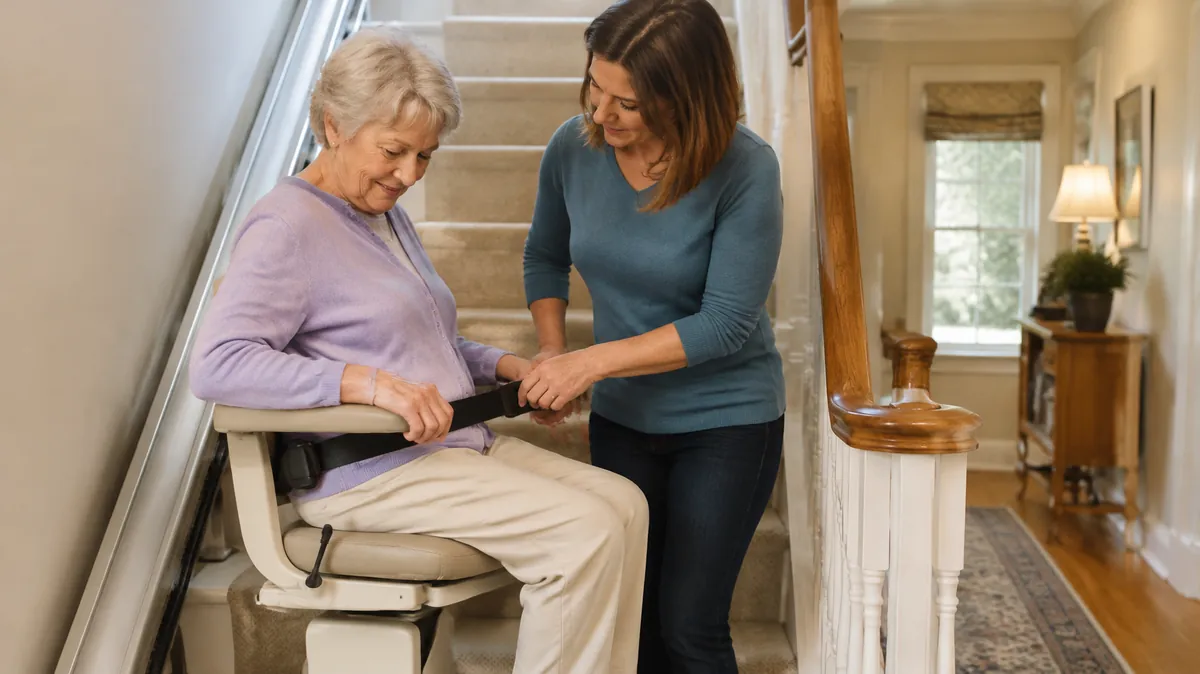
Short answer: a stairlift can be safe when the person can transfer onto the seat, stay seated and use the controls, when it is installed professionally and maintained, and when the stairs stay clear. It becomes a risk when one of those is missing. The sources we read name three groups to be careful about: people who cannot transfer safely, people who cannot stay seated or operate the controls, and some people with dementia. An occupational therapist can assess your parent before you buy.
We found no independent injury statistics for stairlifts, so this guide does not give a risk figure. It summarizes safety advice from a nonprofit working group, an occupational therapy association report, an insurer’s guideline and two consumer sites. Some of those sources are commercial, and we say which. This is not medical advice.
In this guide
The main risks
| Risk | What can go wrong | What the sources suggest |
|---|---|---|
| Unsafe transfer | Falling while getting on or off the seat, especially at the top or bottom of the stairs. | Have the installer confirm your parent can get on and off at both ends, and leave enough clearance there. |
| Standing too soon | Getting up before the chair has fully stopped and locked. | Wait for the chair to stop, and use a lift with a locking swivel seat. |
| Obstructions | Shoes, cords, pets or children on the stairs or track. | Keep the staircase clear; use a key lock; look for obstruction sensors. |
| Malfunction or poor upkeep | A lift stopping mid-track, moving slowly or making unusual noises. | Professional installation and regular maintenance. ConsumerAffairs warns against DIY repair. |
| Used lift from an unverified seller | It may lack some safety features. | Buy from a verified source. See our guide to used and refurbished stairlifts. |
| Not being able to operate it | Forgetting the controls or not handling an unexpected problem. | Assessment first; see the dementia section below. |
Table sources: ConsumerAffairs, Retirement Living (commercial affiliate site), Alzheimer Scotland and the Canadian Association of Occupational Therapists. Our grouping.
Safety features to look for
ConsumerAffairs and Retirement Living both list the following. Ask any seller which ones are standard on the model you are pricing and which cost extra:
- Seat belt to keep the rider in place. Retirement Living says some are center-clasp belts and some are full 5-point harnesses.
- Obstruction sensors that stop the lift gently when something is in the way.
- Locking swivel seat so the chair does not move until the seat is secured. Some swivels are powered.
- Battery backup for power outages, with a charging point where the chair parks.
- Key lock to stop unauthorized use, such as by children.
- Speed limiter and brakes that stop the lift if it moves too fast.
- Folding footrest and rail so they do not become tripping hazards.
- Armrests and footrest for a stable seated position, and emergency stop controls.
- Diagnostic display that flags faults or maintenance needs.
These lists come from consumer pages, not a safety standard. We do not rate any model.
Who should not use one
- People who cannot safely get onto or off the seat (Retirement Living; Commonwealth Care Alliance).
- People who cannot sit safely without help keeping their balance (Commonwealth Care Alliance), or cannot stay seated during the ride (Retirement Living).
- People who cannot operate the controls safely (both sources above).
- Anyone over the lift’s weight capacity. Retirement Living says heavy-duty models reach about 600 pounds, and the Canadian OT association report on one model lists 350 pounds, so check the model.
The Commonwealth Care Alliance document is an insurer’s medical necessity guideline, so it describes when that insurer approves coverage, not a clinical standard. It also expects a physical or occupational therapist to evaluate the person. If your parent must stay in a wheelchair for transfers, read our guide to stairlift alternatives.
If your parent has dementia
A working group at Alzheimer Scotland argues that dementia should not automatically rule someone out and that people should be offered a proper assessment. It also says the main concern is a stairlift installed for someone who cannot learn to use it. Questions it suggests asking:
- Can your parent keep their attention on the task, remember how to operate the lift and learn a new routine?
- Does the unfamiliar situation change how they cope?
- Is someone available to help every time the lift is used?
- Could occupational therapy improve their abilities, and if not, what is the alternative?
- Can your parent handle an unexpected problem, such as a seat that does not fully lock or a control that sticks?
The same group notes that curved and hinged models are harder to operate, and it used cognitive screening tools (the MoCA and the Allen Cognitive Level Screen) in its own assessment pathway. We cannot tell you which test fits your parent, so ask their doctor or an occupational therapist. For wandering risk around stairs, see dementia wandering at night.
Before you buy: a checklist
- Ask your parent’s doctor for an occupational therapy referral. The Canadian OT association report recommends consulting an occupational therapist.
- Check transfer ability (or who will help), seated stability, whether your parent can operate the controls, and the space at the top and bottom of the stairs.
- Try a model in a showroom first, as the same report recommends, if one is nearby.
- Check that the stairs stay wide enough for other people. The report notes a stairlift takes up considerable stair width.
- Ask which safety features are included, who installs it, and what maintenance is needed.
- Think ahead: the report suggests considering progressive medical conditions, resale value, and, for renters, permissions.
- Compare with alternatives and check funding. Start with our stairlift cost guide and help paying for a stairlift.
Safe use at home
- Keep the stairs clear of shoes, cords and clutter, and keep pets and children away from the moving lift.
- Wait for the chair to stop and the seat to lock before standing.
- Park the chair at its charging point and include battery checks in maintenance.
- In an outage, use the lift only when you need to, to save the battery.
- Keep the stairs well lit and add a grab bar near the top and bottom. See our grab bar guide.
- Have the lift serviced at least yearly. Retirement Living recommends annual maintenance.
- Have a way to call for help. Our guide to fall detection covers options, and what to do after a parent falls covers the first steps.
Common questions
Can a stairlift cause a fall?
It can if it is used wrongly, installed badly or not maintained. ConsumerAffairs lists malfunctions, obstructions on the track, tripping hazards at the top and bottom of the stairs, standing before the chair has fully stopped and locked, DIY installation or repair, and buying a used lift from an unverified source. Retirement Living, a commercial affiliate site, lists similar risks. Neither page gives injury statistics.
Who should not use a stairlift?
Retirement Living says people who cannot safely transfer onto the seat, stay seated during the ride or operate the controls should not use one. An insurer’s guideline from Commonwealth Care Alliance also treats a stairlift as not appropriate when the person cannot safely get on or off the seat, cannot sit safely without help keeping their balance, or cannot operate the controls alone. An occupational therapist can assess this.
Is a stairlift safe for someone with dementia?
It depends on the person. A working group at Alzheimer Scotland says cognitive change may affect whether someone can learn to use a stairlift, that curved and hinged models are harder to operate, and that dementia should not automatically rule someone out. It recommends an assessment that looks at attention, memory and whether someone is available to help each time. See below for the questions to ask.
What happens to a stairlift when the power goes out?
ConsumerAffairs says lifts have rechargeable batteries that keep them running through an outage. It cites one manufacturer as saying a full charge typically covers about 10 to 15 round trips, depending on stair length, rider weight and battery condition. A Canadian occupational therapy association report on one model says two batteries keep the lift running so a user is not stranded on the stairs. Park the chair at its charging point so the battery stays full.
Should I get an occupational therapist to assess it?
The Canadian Association of Occupational Therapists report recommends consulting an occupational therapist and confirming that the user has adequate transfer ability or help, trunk stability when seated, the cognitive capacity to operate the lift, and enough space at the top and bottom of the stairs. Ask your parent’s doctor for a referral to an occupational therapist.
Are there safer alternatives?
Sometimes. If your parent cannot transfer onto a seat, look at the options in our guide to stairlift alternatives, such as a platform lift, a through-floor lift, a home elevator, or living on one floor.
One important caveat
This guide is general information and not medical advice. Nobody on this site is a doctor, nurse or occupational therapist. A stairlift decision for someone with balance problems, memory loss or limited mobility should involve their doctor or an occupational therapist. We have not tested or rated any stairlift.
Sources
Alzheimer Scotland, Stairlift poster (2019, working group findings). Canadian Association of Occupational Therapists, product recognition report on a Stannah stairlift (updated November 2020; Stannah Canada is the manufacturer contact, so it is a product-specific report). Commonwealth Care Alliance, stair lift medical necessity guideline (January 2023; an insurer’s coverage guideline). ConsumerAffairs, Are Stair Lifts Safe? (commercial). Retirement Living, Are Stairlifts Safe? (commercial affiliate site). We opened these pages in November 2026. The tables and checklists are our own summary. We welcome corrections through our contact page.