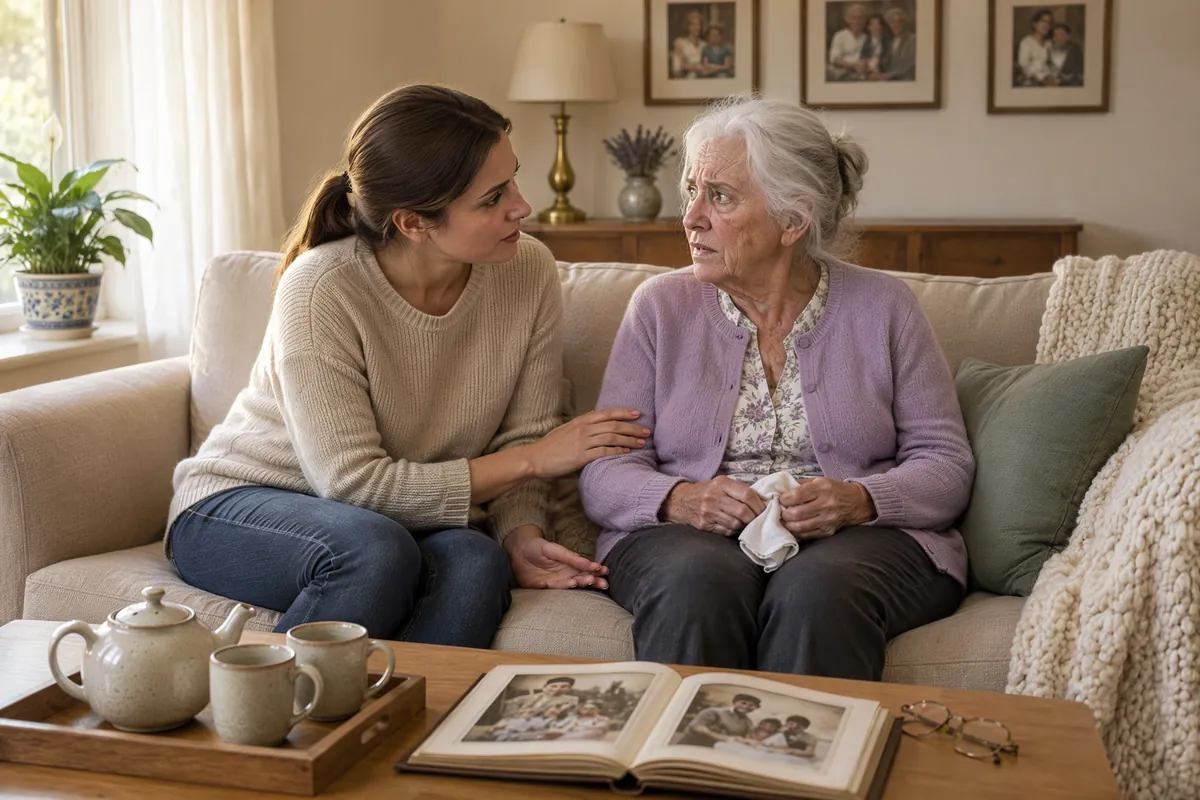
Your mother has never raised her voice at you. Now she shouts, accuses, grips your wrist or swings at you when you help her dress. It is frightening, and many caregivers feel ashamed or alone when it happens. It is also common enough that the National Institute on Aging and the Alzheimer’s Association both publish guidance on it.
This guide summarizes that guidance: why it happens, what to try in the moment, how to stay safe, and when to get a doctor involved. It is general information and not medical advice.
The short answer
Aggression in dementia usually has a cause, such as pain, infection, tiredness, noise or a request that feels confusing. In the moment, stay calm, lower your voice, reduce stimulation and respond to the feeling rather than the words. Afterwards, think about what happened just before and book a medical checkup, especially if the change was sudden. If anyone is in danger, step back and call your local emergency number.
In this guide
Why does a person with dementia become aggressive?
The Alzheimer’s Association says aggression can be verbal or physical, and that it can come on suddenly with no obvious reason or follow a frustrating situation. The National Institute on Aging puts it simply: most of the time agitation and aggression happen for a reason. The reasons the two sources list fall into three groups.
| Type | Possible causes named by the sources | What you can check |
|---|---|---|
| Physical discomfort | Infections such as a urinary tract infection, pain the person cannot describe, poor sleep, hunger or thirst, medication side effects, constipation, a soiled brief | Pain, bathroom needs, food and drink, recent medicine changes |
| Surroundings | Noise, clutter, crowds, unfamiliar people even at home, feeling lost, a sudden change in a familiar place, time of day | Visitors, television, a rearranged room, late afternoon routines |
| Communication and feelings | Complicated instructions, too many questions at once, being pushed to bathe or remember when it is very hard, loneliness, a feeling of loss, picking up a caregiver’s stress | How many steps you asked for, your own tone, how much company they have |
Both sources frame the behavior as a reaction to discomfort, surroundings or communication, which is why looking for the trigger is the first step.
What should you do in the moment?
The Alzheimer’s Association lists these steps for responding:
- Stay calm and speak slowly and softly, in a reassuring tone.
- Focus on the emotion, not the specific words or details. “You sound upset” works better than correcting what was said.
- Check for pain as a cause.
- Reduce distractions and change the surroundings to avoid similar triggers.
- Switch to a different activity, or try music, massage or exercise.
- Step away for a break if your parent is safe and you are able.
- Get help from others if the person cannot calm down.
The National Institute on Aging adds: reassure calmly and listen, and keep a safe distance until the behavior stops.
How can you reduce it?
Afterwards, when things are quiet, look back. The Alzheimer’s Association suggests identifying what happened just before the reaction. The National Institute on Aging suggests acting early and not ignoring the problem. Both point to the same ideas:
- Keep routines consistent, with quiet time built in between activities.
- Let your parent keep as much control as possible, by offering simple choices.
- Keep favorite objects and photos nearby.
- Reduce noise, clutter and crowds.
- Schedule hard tasks for a better time of day. The Alzheimer’s Association notes that mornings are often best.
- Limit caffeine, and try gentle touch, soothing music, reading or walks.
If it tends to happen at bath time or mealtimes, see our guides to a parent who refuses to bathe and one who refuses to eat. If evenings are the hard part, read dementia wandering at night. A simple daily log helps you spot patterns and gives the doctor something specific.
What about safety?
The National Institute on Aging advises protecting yourself and others, keeping a safe distance until the behavior stops, and protecting the person from self-harm. The Alzheimer’s Association says to make sure you and the person are safe, to ask others for help if they cannot calm down, and to call 911 in emergencies, telling responders that the person has dementia, which can cause aggressive behavior. Outside the United States, use your local emergency number. Our guides to making a home safer for dementia and leaving a person with dementia alone cover the practical side.
When should you call the doctor?
Do not wait for a crisis. The Alzheimer’s Association says anyone with behavioral symptoms should have a thorough medical checkup, especially when the symptoms appear suddenly, because treatment depends on a careful diagnosis. The National Institute on Aging says to ask for a medical exam to find causes, and to ask whether medicine could prevent or reduce the symptoms. Bring your notes: what happened, when, what came just before, and any recent change in medicines. Our medication reminders guide can help you keep that list.
How do you look after yourself?
Caregivers who are exhausted find it harder to stay calm, and the Alzheimer’s Association notes that people with dementia can pick up on a caregiver’s stress or irritability. Take breaks, ask others to step in, and share ideas with other caregivers. See the signs of caregiver burnout, respite care options, and our Caregiver Command Center for keeping notes, contacts and routines in one place.
How we handle this guide
AgingSteady earns a commission on some links and sells the Caregiver Command Center, as explained in our affiliate disclosure. The causes and responses come from the sources below.
The Aging Parent Emergency Info Sheet
Medications, contacts and legal info on one page, ready for a paramedic or hospital.
Common questions
Why does my parent with dementia suddenly get aggressive?
There is usually a reason, even when it is not obvious. The Alzheimer's Association lists physical discomfort such as infections, pain the person cannot describe, tiredness, hunger or thirst, and medication side effects. It also lists overstimulation from noise, clutter or crowds, and poor communication such as too many questions at once. The National Institute on Aging says most of the time agitation and aggression happen for a reason.
Should I call the doctor about aggressive behavior?
Yes. The Alzheimer's Association says anyone with behavioral symptoms should have a thorough medical checkup, especially when the symptoms appear suddenly, because treatment depends on a careful diagnosis. The National Institute on Aging suggests asking for a medical exam to look for causes, and asking whether medicine could prevent or reduce symptoms.
How do I calm a person with dementia who is angry?
The Alzheimer's Association suggests staying calm, speaking slowly and softly, reducing distractions, and focusing on the emotion behind the words rather than the details. It also suggests calming activities such as music, massage or exercise, or switching to a different activity. If the person cannot calm down, get help from others.
What should I do if my parent hits or tries to hurt me?
Make sure you and your parent are safe. The National Institute on Aging advises keeping a safe distance until the behavior stops and protecting the person from self-harm. The Alzheimer's Association says to call 911 in an emergency and to tell responders that the person has dementia, which can cause aggressive behavior.
Is it my fault when my parent gets aggressive?
No. The Alzheimer's Association notes that people with dementia can pick up on a caregiver's stress or irritability, which is a reason to take care of yourself, not a reason to blame yourself. Stay calm where you can, and take breaks.
Where can I get support as a caregiver?
The Alzheimer's Association points to its online community, ALZConnected, for sharing strategies. Our guide to respite care covers getting a break.
One important caveat
This guide is general information and is not medical advice. It cannot diagnose why your parent is aggressive or tell you which treatment is right. A doctor who knows your parent can. If anyone is in danger, call your local emergency number and say that the person has dementia.
Sources
Alzheimer’s Association, Aggression and Anger (no article date shown; page footer 2026). · National Institute on Aging (NIH), Coping with Agitation and Aggression in Alzheimer’s Disease, May 2017, as redistributed by Alzheimer’s Orange County in June 2022 (older than the Alzheimer’s Association page, so check the NIA site for any newer version). We opened both pages in November 2026. We welcome corrections through our contact page.